The Complete History of Clare GAA – From the Burren to Five All-Irelands
Five All-Ireland hurling titles. An 81-year wait between the first and the second – the longest gap in championship history. A schoolteacher from the Burren who built the biggest amateur sports body on earth. A squad of unknowns who tore apart the old order of hurling in a single summer. And, in 2024, a captain lifting the Liam MacCarthy Cup in extra time while 40,000 Clare voices shook Croke Park.
This is not just a story about sport. This is the story of a county that kept coming back, kept believing, and kept rewriting the rules.
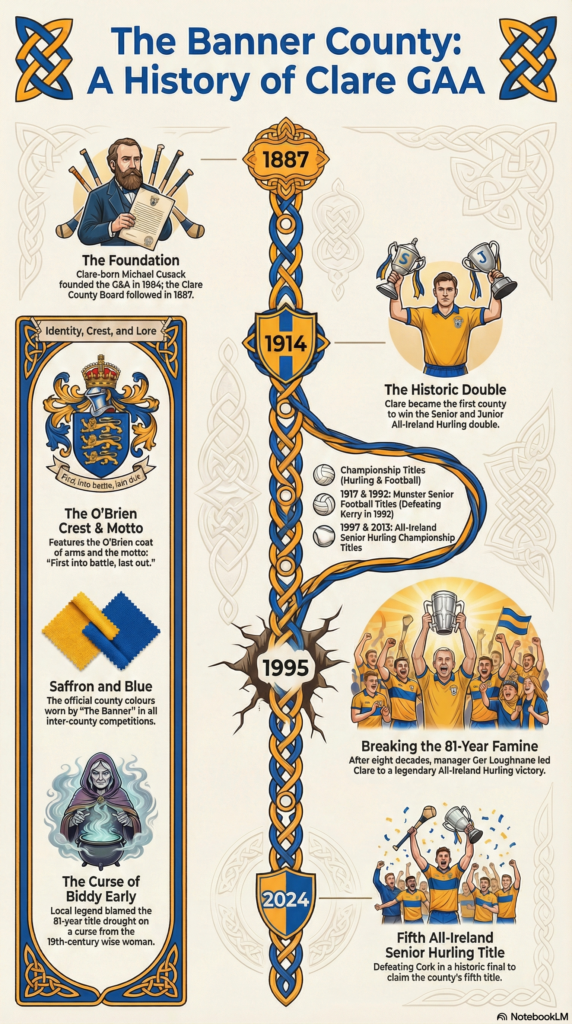
Clare GAA has lived through famine and revolution, decades of heartbreak and nights of pure magic. From Michael Cusack’s thatched cottage in Carron to Tony Kelly climbing the steps of the Hogan Stand, every chapter of this history carries the DNA of a county that refuses to accept its place in the pecking order.
Here is all of it.
Michael Cusack – The Man Who Started It All
Every story needs a beginning, and the story of Clare GAA begins in the most unlikely of places: a three-room thatched cottage on the eastern edge of the Burren, in the parish of Carron, County Clare.
Michael Cusack was born there on 20 September 1847 – Black ’47, the darkest year of the Irish famine. His parents, Matthew and Bridget, were Irish-speaking. The Burren, that strange lunar landscape of limestone and wildflowers, was their world. Young Michael didn’t speak a word of English until he was about eleven years old.
But Cusack was sharp. He trained as a teacher, moved through schools in Enniscorthy, Galway, Newry and eventually Dublin, where he opened Cusack’s Academy – a private school where sport and education went hand in hand. He was a big man with a big personality. He played rugby, cricket, and hurling. He threw the shot put. And he burned with a single idea: that Irish people should play Irish games, on their own terms, run by their own people.
The problem was simple. Organised sport in 1880s Ireland was run by the Anglo-Irish elite. Games were scheduled on Saturdays – a workday for most Irish people. Labourers, farmers, and tradesmen were banned from competing. Hurling, the ancient game Cusack had grown up with in Clare, was fading fast.
So Cusack did what Cusack always did. He acted.
On 1 November 1884, in Hayes’s Hotel in Thurles, County Tipperary, Cusack and seven others founded the Gaelic Athletic Association – the GAA. Maurice Davin became president. Cusack became secretary. Archbishop Croke, Charles Stewart Parnell, and Michael Davitt signed on as patrons. Within eighteen months, 50,000 people had joined. Cusack himself described how the new body spread like a “prairie fire.”
He was voted out of his own organisation within two years – too headstrong, too abrasive, too unwilling to play committee politics. He died in Dublin in 1906, aged 59, largely forgotten and nearly broke. The GAA voted him £50 in recognition of his unpaid work.
Today, the GAA has over 1,600 clubs across Ireland and the world. Cusack Park in Ennis carries his name. The Cusack Stand at Croke Park, the biggest stadium in Ireland, carries his name. His cottage in Carron has been restored and stands as a visitor centre telling his story. James Joyce turned him into “the Citizen” in Ulysses – a loud, belligerent patriot. But the real Cusack was something else entirely. He was a Clare schoolteacher who changed Ireland.
“No movement having for its object the social and political advancement of a nation can be regarded as perfect if it has not made adequate provision for the preservation and cultivation of the National pastimes of the people.” – Michael Cusack, 1884
The Early Years – 1884 to 1913
Clare GAA was among the first county boards in the country. The inaugural meeting took place on 14 February 1887, just over two years after the GAA’s founding. Twenty-two clubs entered the first Clare Senior Hurling Championship that year. Smith O’Brien’s, from Garranboy near Killaloe, won the first-ever title, beating Ogonnelloe in the final.
In the same year, Clare’s hurling and football club champions took part in the first All-Ireland Championships – the only time they were held on an open-draw basis. The footballers of Newmarket-on-Fergus fell to Templemore (Tipperary), and the hurlers of Smith O’Brien’s lost to Thurles. Both games were played in Nenagh.
By 1889, Clare had reached its first All-Ireland Senior Hurling Championship Final. Tulla represented the county and faced Dublin Kickhams at Croke Park. It ended in defeat: Dublin 5–1, Clare 1–6. But the marker had been laid. Clare could compete.
The 1890s were dominated at club level by Tulla, who won eight county titles, including a famous five-in-a-row from 1896 to 1900. In those early decades, hurling in Clare was raw and wild. Games were played on borrowed farmland. There were no goalposts, no markings, and no dressing rooms. Players funded their own travel. But the game was alive, and it was theirs.
Meanwhile, Clare football was finding its feet too. The county reached its first Munster Senior Football Championship final in 1912, losing to Kerry. Deciders were lost again in 1915 (to Kerry) and 1916 (to Cork by a single point). But those defeats were sharpening the team. By 1917, Clare football was ready to roar.
1914 – Clare’s First All-Ireland
The year 1914 is one of the great chapters in Clare GAA history – and one of the least-known stories in the wider world of hurling.
In the Munster Championship, Clare opened with a 7–3 to 4–1 demolition of Kerry. A semi-final against Limerick had to be moved because the British Army was occupying the Markets Field in Limerick city – a sign of the political tensions rippling through Ireland.
Then came the Munster Final on 14 June 1914 at Thurles. The referee was Tom Semple, the Tipperary legend after whom the stadium is now named. Cork were the opposition. It was a war. After extra time, Clare came out on top: 3–2 to 3–1. Goals from Jim Guerin and a brilliant team effort carried the day.
Clare hammered Galway 6–6 to 0–0 in the All-Ireland semi-final, setting up a final against Laois at Croke Park on 18 October 1914 – only one year after the GAA had purchased the ground.
The result: Clare 5–1, Laois 1–0 (some sources record it as 2–4 to 1–2 under different scoring rules of the era). Amby Power of Quin became the first man to captain Clare to an All-Ireland hurling title.
One of the youngest players on the team was Brendan Considine, a teenager from Ennis. He was among the youngest All-Ireland senior medal winners in GAA history. Considine’s career would take him across Ireland as a bank official – he later won an All-Ireland with Dublin in 1917 and played for Cork and Waterford too. His 1914 medal is now held in Clare Museum.
The match ball from that 1914 final also survives. It’s bigger and browner than modern sliotars – harder to see, harder to hit. The trainer Jim O’Hehir collected it after the final whistle. His son, Mícheál Ó hEithir (born in Dublin, 1920), would go on to become the most famous voice in the history of GAA broadcasting.
Clare also won the All-Ireland Junior Hurling Championship in 1914 – beating Laois again – making them the first county ever to win both senior and junior titles in the same year.
It was a golden year. Nobody in Clare could have imagined what came next.
1917 – Clare Football’s Finest Hour (Almost)
While the hurlers basked in 1914’s glory, Clare’s footballers were about to write their own chapter.
In 1917, Clare won the Munster Senior Football Championship for the first time, destroying Cork on a scoreline of 5–4 to 0–1 – an 18-point demolition. They beat Galway in the All-Ireland semi-final, 2–1 to 0–5. For the first and still only time, Clare reached an All-Ireland Senior Football Championship Final.
The opponents were Wexford, who were in the middle of a four-in-a-row run (1915–1918). Clare fell short: Wexford 0–9, Clare 0–5. It remains the closest the Banner County has ever come to football’s ultimate prize.
That generation of Clare footballers also reached Munster finals in 1915 and 1916, so the 1917 breakthrough came from a seasoned group of players who had been knocking on the door for years.
The Long Desert – 1915 to 1994
After the glory of 1914, Clare hurling entered a wilderness that would last the better part of a century.
There were flashes. In 1932, Clare won the Munster title by beating Cork 5–2 to 4–1 and reached the All-Ireland Final. But Kilkenny were waiting, and they won 3–3 to 2–3. It was a close-run thing – tantalisingly close – but Clare had come up short on the biggest stage.
Then… nothing. Decade after decade, Clare teams would win league games, build hope, and crash out of the championship. Munster was a walled garden patrolled by Cork, Tipperary, and Limerick. For a county like Clare, beating one of those three in a knockout game felt almost impossible. Beating two of them in the same summer? Unthinkable.
The 1970s and 1980s were especially painful. Clare reached Munster finals in 1977 and 1978, losing to Cork both times. “It was the worst defeat ever,” Ger Loughnane – then a player – said of the 1978 loss, a 0–13 to 0–11 defeat that felt like a last chance slipping away. Clare teams of that era existed in what one writer called “a state of anxiety” – talented enough to dream, not strong enough to believe.
In 1993, Clare made it back to the Munster Final under manager Len Gaynor. Tipperary hammered them. In 1994, Limerick did the same. Two brutal Munster Final losses in two years. The few Clare supporters who made those journeys came home wondering if it would ever change.
But something was stirring. Gaynor’s selector was a fiery, intense schoolteacher from Feakle named Ger Loughnane. And he had a plan.
The Football Miracle of 1992 – “There Won’t Be a Cow Milked in Clare”
Before the hurlers turned the world upside down, it was the footballers who gave Clare its first taste of modern glory.
In 1990, a 28-year-old Mayo man named John Maughan arrived in Clare to manage the senior football team. He was a recently retired player working as an officer in the Irish Army. Only eleven players showed up to his first training session.
Maughan took off his Mayo jersey to reveal a Clare jersey underneath. The message was clear: he was all in. He ran training sessions on Lahinch beach and Crusheen Hill, and he ran them alongside the players. His wife Audrey, a formidable athlete, sometimes trained with them too. Full-back Seamus Clancy’s early goal was just to finish ahead of Audrey in the fitness runs.
Slowly, painfully, Clare improved. They won the All-Ireland ‘B’ Championship in 1991. They reached a league quarter-final in 1992, losing by only two points to Meath, one of the dominant teams of the era. By the time the championship came around, something had clicked.
Clare beat Tipperary in the Munster semi-final and earned a date with Kerry in the 1992 Munster Senior Football Championship Final – their first provincial decider in 75 years.
Kerry had Jack O’Shea, a living legend with seven All-Ireland medals. It was, as it turned out, Jacko’s last game. Seamus Moynihan made his senior debut on the same day.
Clare should have been out of sight in the first half. They missed a penalty, missed chances. But they led by one at half-time. In the second half, Colm Clancy and Martin Daly scored the goals that broke Kerry’s back. The final score: Clare 2–10, Kerry 0–12.
RTÉ commentator Marty Morrissey, himself a Clare man from Kilmurry-Ibrickane, uttered the line that would follow him for the rest of his career: “There won’t be a cow milked in Clare tonight.”
It was the only year from 1936 to 2020 that neither Kerry nor Cork won the Munster football championship. Seamus Clancy won an All-Star for his performances that year.
Clare lost the All-Ireland semi-final to Dublin, 3–14 to 2–12, in front of a packed Croke Park. But the damage was done. Clare had proven they could beat the best. And the hurlers were watching.
As Anthony Daly later put it: “We love our music and our hurling in Clare, but we also love our football. The footballers drove us on.”
The Revolution – Ger Loughnane, 1995–2000
If the 1990s were hurling’s “Revolution Years” – as Denis Walsh titled his famous book – then Ger Loughnane was the revolution’s firebrand.
Loughnane had been a Clare hurler himself, a combative wing-back from Feakle who played from 1973 to 1987. He lost 11 deciders at different levels during his playing career. He knew what losing felt like, and he knew why Clare kept losing: they weren’t physically ready. They weren’t mentally ready. They didn’t believe they belonged.
He was going to change that or break everyone in the process.
The Winter of Crusheen
When Loughnane took over in late 1994, he and trainer Mike McNamara subjected the Clare panel to a winter of physical conditioning that became the stuff of legend. Running in Crusheen. Hill sprints in Shannon. Training matches where the intensity went beyond anything most players had experienced.
“The training was extreme at times,” Loughnane recalled. “But the leaders on the team never flinched. And when other fellas were beginning to doubt or wilt, they couldn’t wilt in the face of the leaders.”
Those leaders were everywhere. Anthony Daly, the Clarecastle half-back who captained the team with raw emotion. Seánie McMahon from St Joseph’s Doora-Barefield, one of the best centre-backs hurling has ever seen. Brian Lohan, the giant full-back from Wolfe Tones, Shannon – a man who could shut down any forward in the country. Jamesie O’Connor of St Joseph’s, the razor-sharp forward. Davy Fitzgerald in goal, fearless and eccentric. Ger ‘Sparrow’ O’Loughlin, the Clarecastle forward who could score from anywhere.
1995 – The Breakthrough
Clare topped the Division 1 League table but lost the final to Kilkenny. “Different class,” muttered Phil Hogan behind Loughnane’s wife on the way out. Loughnane heard about it. It fuelled him.
In the Munster semi-final, Clare trailed Cork in the dying minutes. Then Ollie Baker doubled on a Fergie Tuohy sideline cut and buried it in the net: Clare 2–13, Cork 3–9. The Banner were in a Munster Final – their third in a row, having lost the previous two.
There was one more thing. A Limerick player had allegedly told Anthony Daly that Clare were “only a league team.” Loughnane stored it. He always stored these things.
On a scorching day in Thurles, Clare dismantled Limerick: 1–17 to 0–11. Davy Fitzgerald saved their only penalty. Clare dominated from start to finish. After 63 years, the Munster title was back across the Shannon.
The 1995 Munster Final was on tape delay on RTÉ. It was a different world. By September, these Clare players would be household names.
In the All-Ireland semi-final, Clare beat Galway 3–12 to 1–13, with Sparrow O’Loughlin hitting 2–1 and Jamesie O’Connor adding 0–7.
The All-Ireland Final on 3 September 1995 pitted Clare against defending champions Offaly. Nobody outside Clare gave them a prayer. Loughnane told his players that Offaly “can’t handle Clare hurling.” Where he got this from, no one knows. But everyone believed him.
In the second half, an Anthony Daly free came back off the post. Éamonn Taaffe was there to hammer it home. That goal broke Offaly’s spirit. Clare won 1–13 to 2–8.
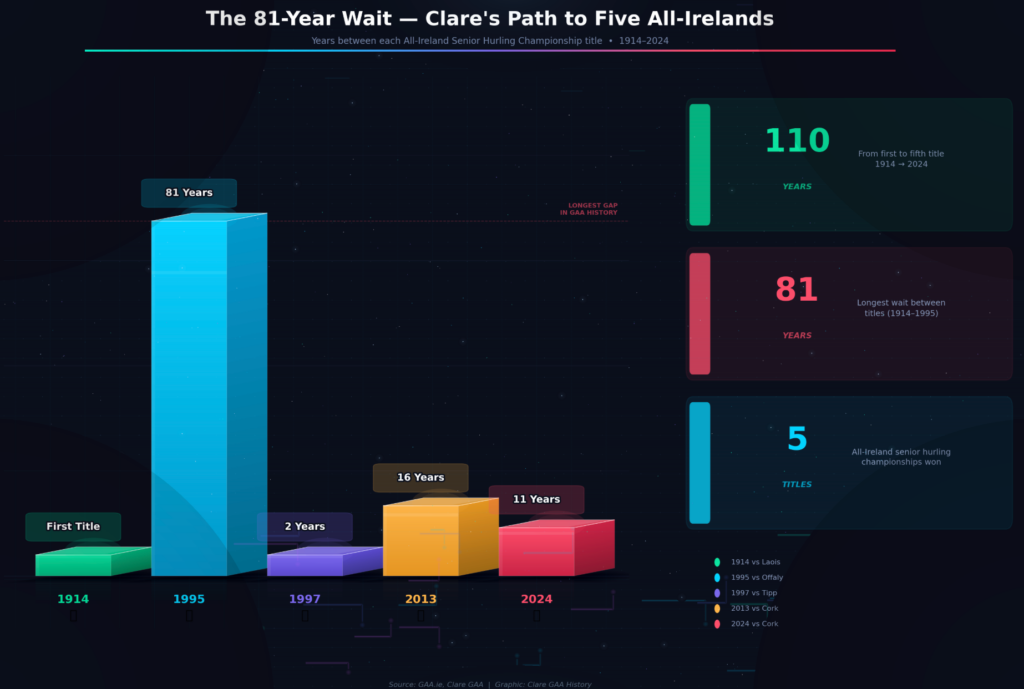
For the first time in 81 years, Clare were All-Ireland hurling champions. The Liam MacCarthy Cup was coming home.
On the bus back to Clare that night, as it crossed the Shannon, Loughnane leaned over to selector Colum Flynn and pointed out the window. A bonfire blazed on a lonely hillside. “That’s it,” Loughnane said. “You’ll never see that hill without a flame again.”
1997 – The Confirmation
If 1995 was the ambush, 1997 was the confirmation. Clare beat Kerry and Cork to reach a Munster Final against Tipperary, winning 1–18 to 0–18. They demolished Kilkenny 1–17 to 1–13 in the All-Ireland semi-final.
The All-Ireland Final was Clare vs Tipperary – two Munster rivals, face to face on the biggest stage. It was savage. A late Tipperary goal put them ahead. The teams were level at 2–13 to 0–19 as the clock ticked down. Then Jamesie O’Connor scored the point heard around Ireland.
Clare were champions again. O’Connor finished with 0–7 and won the Hurler of the Year award.
1998 – Three in a Row in Munster
Clare made it three successive Munster titles in 1998, beating Cork and then Waterford in the provincial decider. But they fell to Offaly in a controversial All-Ireland semi-final – the infamous match that was restarted after referee Jimmy Cooney blew the final whistle early. The replay went Offaly’s way. The fallout was volcanic. Loughnane’s fury at the officials became part of hurling folklore.
Clare beat Galway (after a replay) in the 1999 All-Ireland quarter-final but lost to Kilkenny in the semi. In 2000, Tipperary ended the road in Munster. Loughnane’s reign was over.
His championship record as Clare manager reads: Played 23, Won 13, Drew 5, Lost 5. Two All-Irelands. Three Munster titles. A revolution.
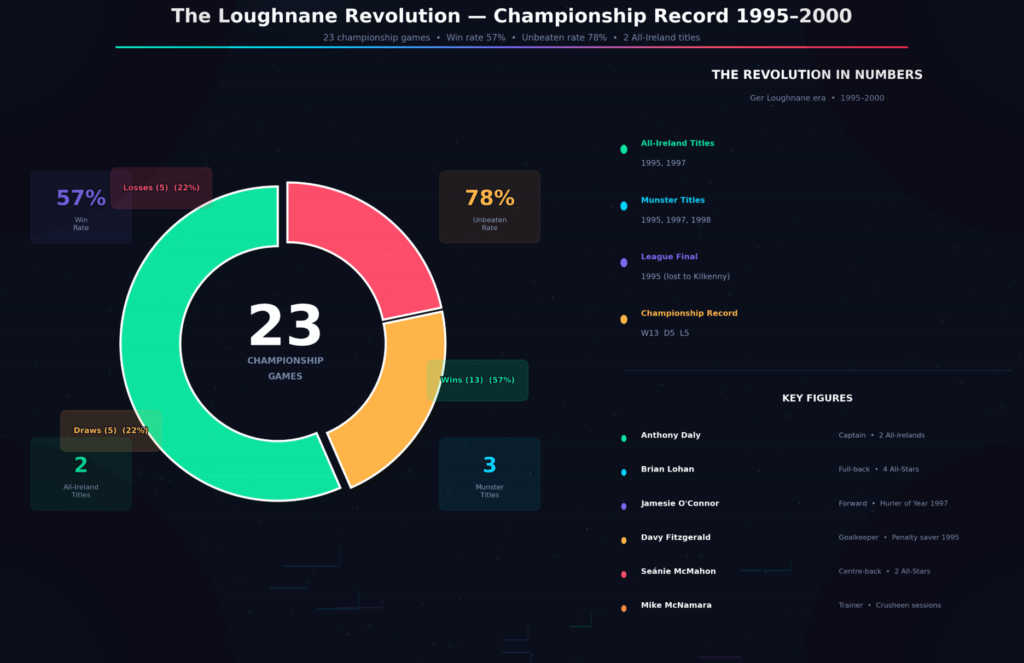
“We weren’t going to achieve anything different unless we did things differently. That was the whole philosophy behind the whole thing.” – Ger Loughnane
The Wilderness Returns – 2001 to 2012
After Loughnane, Clare struggled to find consistency. Cyril Lyons (2001–2003) and Anthony Daly (2004–2006) both had their moments, but the championship breakthrough never came. Tony Considine, Mike McNamara, and Ger O’Loughlin all took their turns. Between 2001 and 2012, Clare won just one championship game in some seasons, and none at all in others.
The low point came under O’Loughlin (2010–2011): four championship games, four defeats. Clare were in Division 1B of the league. It felt like the 1980s all over again.
Then Davy Fitzgerald came home.
2013 – The Return of the Banner
Davy Fitzgerald, the Sixmilebridge goalkeeper who had stood between the posts for both All-Ireland wins in the 1990s, was appointed Clare manager in 2012.
His first task was simple: make Clare competitive again. The team hadn’t won a championship match since 2008. They were in Division 1B.
Clare won 1B to earn promotion. In 2013, things started to click. A young squad – powered by a crop of players who would win the All-Ireland Under-21 title between the drawn senior final and the replay – began to find its stride.
Clare lost to Cork in the Munster semi-final, but the new qualifier system gave them a second chance. They beat Laois, Wexford (after extra time), and then Galway in the quarter-final. In the semi-final, they dismantled Munster champions Limerick 1–22 to 0–18.
Tony Kelly, just 19 years old, was electric. He would finish the year as both Hurler of the Year and Young Hurler of the Year – the only player ever to win both in the same season.
The Drawn Final and the Replay
The 2013 All-Ireland Final – Clare vs Cork on 8 September – was one of the most dramatic games in history. Clare led for most of the match but Cork hit back with goals in the second half. Patrick Horgan’s free put Cork ahead for the first time in injury time. It looked over.
Then Domhnall O’Donovan, a corner-back with no business being that far up the pitch, struck the equalising point with the last hit of the game: Clare 0–25, Cork 3–16. Draw.
The replay on 28 September was even more extraordinary. It was the first senior final played under floodlights. 82,276 packed Croke Park. And Davy Fitzgerald rolled the dice.
He dropped Darach Honan from the starting full-forward position and replaced him with Shane O’Donnell – a 19-year-old UCC student who only found out he was starting two hours before throw-in.
O’Donnell scored 3–3. Three goals and three points, all from play, in an All-Ireland Final. It was a performance out of a fairytale. Clare won 5–16 to 3–16 in what has been called one of the greatest finals of all time.
Captain Patrick Donnellan lifted the Liam MacCarthy and paid tribute to Fitzgerald: “He gives everything he has for this county.” Ger Loughnane, watching from the stands, called it “a magical year.”
Clare’s fourth All-Ireland. And a team loaded with talent that was only getting started.
Brian Lohan and the Long Road Back – 2019 to 2024
After Fitzgerald left in 2016 (he had also won the 2016 National Hurling League), Clare spent three years under the joint management of Donal Moloney and Gerry O’Connor. They reached the 2018 All-Ireland semi-final but couldn’t get over the line.
In late 2019, Brian Lohan was appointed manager. Lohan had been one of the greatest full-backs in hurling history – winner of four All-Stars, two All-Irelands, and named at number six on the Hurling Team of the Millennium. He was a man of few words and intense focus. If Loughnane’s management style was fire and brimstone, Lohan’s was cold steel.
The early years were tough. Covid disrupted the 2020 and 2021 seasons. Clare lost to Tipperary in a heartbreaking 2020 Munster semi-final. In 2021, Lohan overhauled the squad, bringing in young players like David Fitzgerald (Inagh-Kilnamona), Adam Hogan (Feakle), Mark Rodgers (Scariff), and Diarmuid Ryan (Cratloe). The older guard – Kelly, O’Donnell, McInerney, Conlon, Duggan – were still there.
In 2022, Clare won the league but fell to Limerick in the Munster Championship. In 2023, they reached the All-Ireland semi-final before Kilkenny ended their run.
But 2024 was different.
2024 – The Fifth Star
Clare won the 2024 National Hurling League, beating Kilkenny 3–16 to 1–20 in the final. It was their first league title since 2016 and a signal that something big was building.
The Munster Championship was a dogfight. Clare lost to Limerick in Round 1 at Cusack Park but beat Cork, Waterford, and Tipperary to qualify for the Munster Final. Limerick won that one too, but Clare were through to the All-Ireland series.
After seeing off Wexford, Clare faced Kilkenny in the All-Ireland semi-final. A sluggish first half gave way to a storming second, and Clare pulled away to win and book a date with Cork in the final – just like 2013.
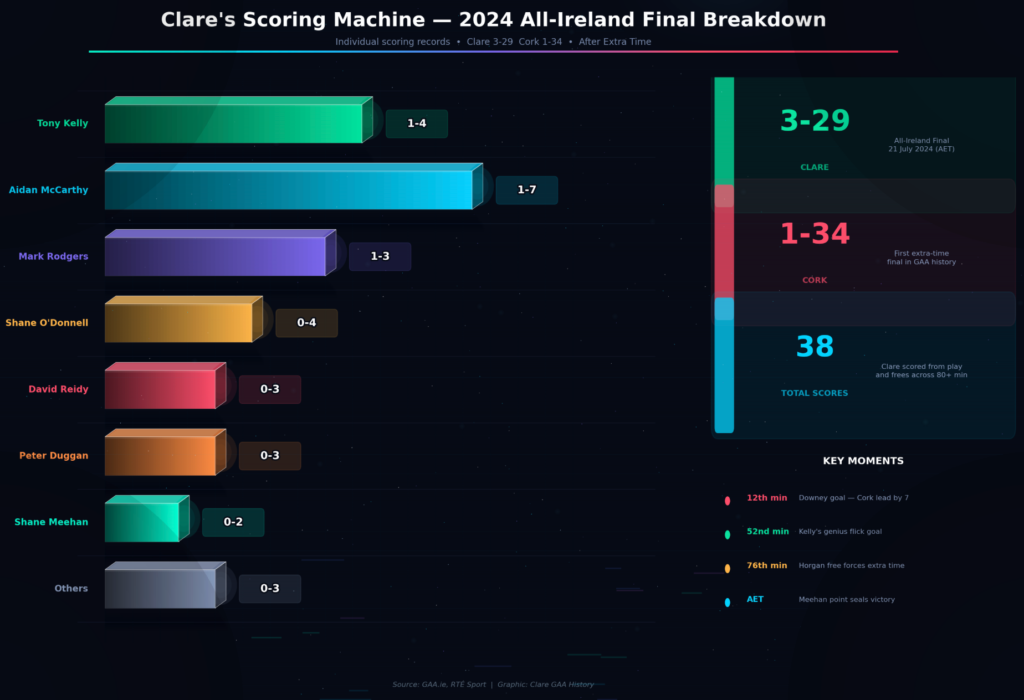
The 2024 All-Ireland Final on 21 July at Croke Park was an instant classic. The teams were level 14 times. Cork struck first with a brilliant Rob Downey goal after just 12 minutes, surging to a seven-point lead. It looked like a Cork procession.
Clare had other ideas. Aidan McCarthy goaled to spark the comeback, finishing with 1–7 (including his famous 1–7 from the 2024 final that echoed the 1997 sensation). Mark Rodgers scored a second goal. And then, in the 52nd minute, Tony Kelly produced a moment of genius – flicking the ball over a defender’s head, touching it on his hurley, and flicking it past the goalkeeper into the corner of the net.
Patrick Horgan’s free in the 76th minute levelled it: 3–21 to 1–27. For the first time in history, an All-Ireland hurling final went to extra time.
Clare found another gear. A burst of four points without reply in the second period of extra time sealed it. Shane Meehan’s point was the last score: Clare 3–29, Cork 1–34. Champions by three.
Within seconds, Lohan was being lifted on the shoulders of his backroom team. Tony Kelly climbed the Hogan Stand steps and called Lohan “a god of Clare hurling.”
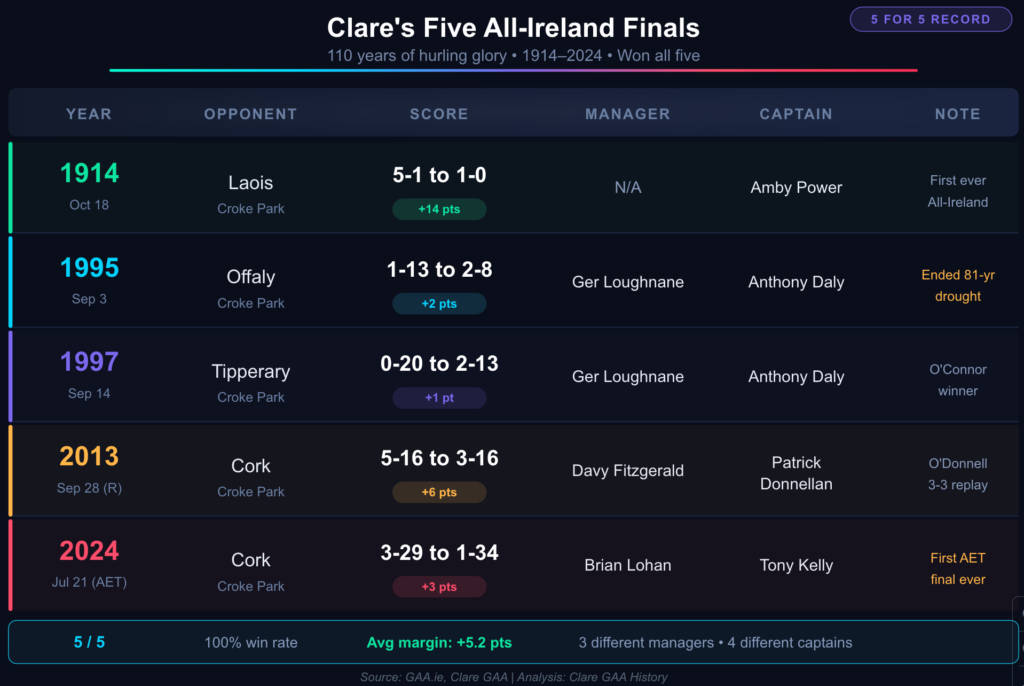
It was Clare’s fifth All-Ireland title, and it completed a set that spans 110 years: 1914, 1995, 1997, 2013, 2024.
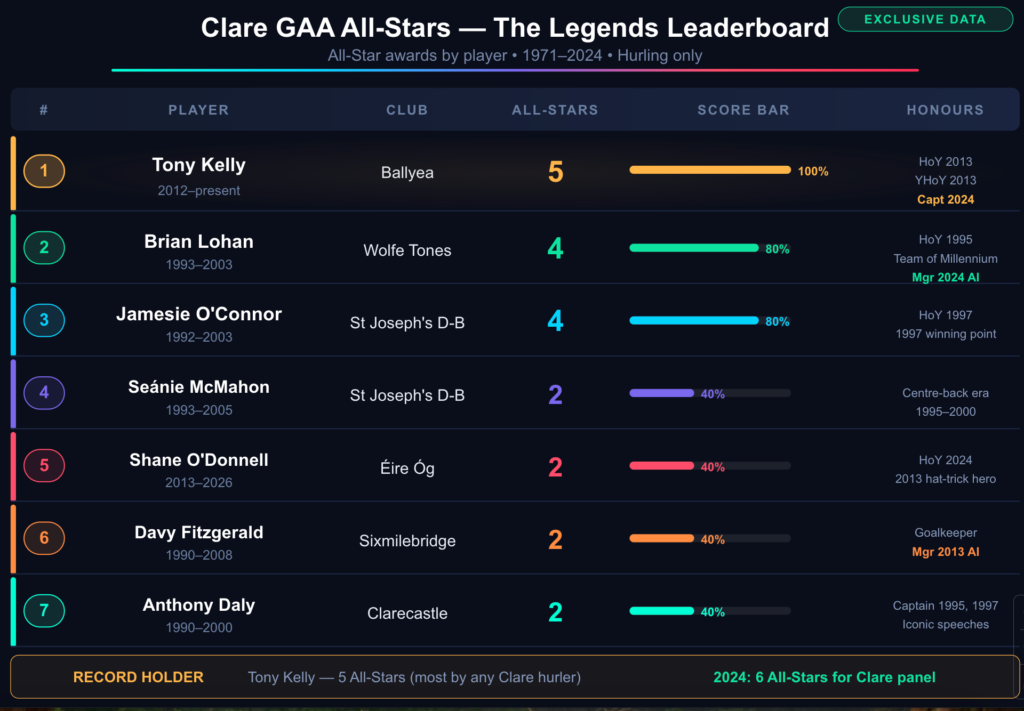
Shane O’Donnell was named Hurler of the Year. Adam Hogan was Young Hurler of the Year. Clare won six All-Star awards. Kelly’s five All-Stars made him the most decorated Clare hurler in history.
Clare Football – A Proud Tradition
While hurling gets the headlines, Clare football has its own rich and sometimes painful story.
The Early Days
Clare won their first Munster Senior Football Championship in 1917, beating Cork 5–4 to 0–1. They reached the All-Ireland Final that year but lost to Wexford 0–9 to 0–5. In the 1920s, Clare reached four more Munster finals – losing all of them to Kerry.
The Dark Ages
Football in Clare hit desperate lows. The “Milltown Massacre” of 1979 remains infamous: Kerry beat Clare 9–21 to 1–9 – a 35-point hammering in Milltown Malbay. In 1953, after a six-goal loss to Kerry, Clare withdrew from the following year’s championship entirely.
The Maughan Years and 1992
Everything changed with John Maughan. His story has already been told above, but the impact of that 1992 Munster Final victory over Kerry went beyond football. It lifted the entire county. It proved that Clare could beat anybody on any given day.
Colm Collins and the Modern Era
In 2013, Colm Collins – from the Cratloe club – took over as Clare football manager. He lasted a decade, a remarkable feat of consistency. Collins took Clare from Division 4 to Division 2 of the league, reaching All-Ireland quarter-finals in 2016 and 2022. RTÉ called him “an icon of stability.”
Clare have continued to compete in Munster. They reached the 2024 Munster SFC Final under Mark Fitzgerald and the 2025 Munster SFC Final under Peter Keane. The footballers may not have won another Munster title since 1992, but they’ve never stopped fighting for one.
Clare Camogie – Growing the Game
Camogie was first established in Clare in 1934, thanks to County Secretary Mick Hennessy of Clooney. The game was revived in 1958 by Peggy Nagle of Ennistymon and Sheila Carroll of Lahinch.
Clare compete in Division 1B of the National Camogie League and have historically been a competitive force at minor and underage levels. The growth of camogie in the county has been one of Clare GAA’s most important recent stories.
Under the GAA’s development plans, five new camogie clubs were targeted for Clare by 2015. The county’s camogie teams now share Cusack Park with the hurlers and footballers, and sponsorship has been extended to cover camogie alongside the men’s teams.
Players like Lorna McNamara, who scored 1–8 in a Division 1B game against Dublin in February 2026, carry the torch for a sport that’s growing fast in the Banner County.
Club Hurling in Clare – The Heartbeat of the County
Everything starts at club level. Every Clare player who ever wore the saffron and blue learned the game in a parish field, on a community pitch, swinging a hurley from the time they could walk.
The Dynasties
Newmarket-on-Fergus are the most successful club in Clare hurling history, with 23 senior championship titles. Their golden era stretched from the 1960s through the 1980s, including two three-in-a-rows and a remarkable four-in-a-row from 1971 to 1974.
Tulla were the early kings, dominant in the 1890s. Ennis Dalcassians won four titles between 1924 and 1934. Feakle, Ger Loughnane’s home club, won five between 1935 and 1944. Ruan, powered by the legendary Jimmy Smyth, won five between 1948 and 1962.
Sixmilebridge and Clarecastle dominated the late 20th century. And from 1995 to 2000, something remarkable happened: Clare’s county champions won six consecutive Munster Club Championships – Clarecastle, Sixmilebridge (twice), Doora-Barefield (twice), and Wolfe Tones.
Two Clare clubs have won All-Ireland Senior Club Hurling Championships: Sixmilebridge in 1996 and Doora-Barefield in 1999.
The Modern Era
Ballyea burst onto the scene with their first-ever senior title in 2016, going on to win the Munster Club Championship. Tony Kelly lines out with Ballyea. In 2023, Feakle ended a 36-year wait for a senior title. In 2025, Éire Óg of Ennis bridged a 35-year gap, completing a hurling-football double for the town of Ennis for the first time since 1929.
The health of the club scene is the reason Clare keeps producing inter-county hurlers. Sixteen clubs contest the senior championship each year, and the competition is fierce.
Cusack Park – The Home of Clare GAA
Cusack Park (now officially Zimmer Biomet Páirc Chíosóg after naming rights were sold in 2025) has been the home of Clare GAA since it was first developed. Named after the county’s most famous son, Michael Cusack, it sits in the heart of Ennis.
The ground originally had a capacity of about 28,000, mostly terraced. A 2011 safety review reduced the capacity to just under 15,000. Between 2009 and 2012, Clare GAA invested over €500,000 in drainage and fencing. Then, in 2015, a major renovation began: the main stand was demolished and rebuilt, and a new entrance was built on the north side.
When the work was completed in late 2017, the capacity increased to 19,000. The first sell-out came on 17 June 2018, when local rivals Limerick visited for a Munster Championship game.
Cusack Park hosts the knockout stages of the Clare Senior Hurling and Football Championships every year. For big inter-county games, it’s a cauldron. When Clare play Limerick or Tipperary in Cusack Park on a summer evening, there are few better places in Ireland to watch a game of hurling.
Clare also has a Centre of Excellence at Caherlohan near Tulla, which serves as the county’s training base.
Clare GAA All-Stars and Individual Honours
Clare hurlers have won numerous All-Star awards and individual honours across the decades:
Hurler of the Year
| Year | Player | Club |
| 1995 | Brian Lohan | Wolfe Tones |
| 1997 | Jamesie O’Connor | St Joseph’s Doora-Barefield |
| 2013 | Tony Kelly | Ballyea |
| 2024 | Shane O’Donnell | Éire Óg |
Young Hurler of the Year
| Year | Player | Club |
| 2013 | Tony Kelly | Ballyea |
| 2023 | Mark Rodgers | Scariff |
| 2024 | Adam Hogan | Feakle |
All-Star Records
Tony Kelly holds the record for most All-Star awards by a Clare hurler with five (2013, 2020, 2021, 2022, 2024). Brian Lohan and Jamesie O’Connor each won four.
The 1995 All-Ireland winning team was loaded with All-Star talent: Davy Fitzgerald, Brian Lohan, Seánie McMahon, Anthony Daly, Jamesie O’Connor, and others were all honoured over the course of the decade.
In 2024, Clare’s six All-Stars were: Adam Hogan, David McInerney, Tony Kelly, David Fitzgerald, Mark Rodgers, and Shane O’Donnell.
Football All-Stars
Seamus Clancy won Clare’s only senior football All-Star in 1992 for his performances in the Munster Championship-winning campaign.
Clare GAA Managers – A Timeline
| Period | Manager | Key Achievements |
| 1981–1983 | Fr. Harry Bohan | League successes |
| 1992–1994 | Len Gaynor | Munster Final appearances (1993, 1994) |
| 1995–2000 | Ger Loughnane | 🏆 All-Ireland 1995, 1997. Munster 1995, 1997, 1998 |
| 2001–2003 | Cyril Lyons | – |
| 2004–2006 | Anthony Daly | – |
| 2007 | Tony Considine | – |
| 2008–2009 | Mike McNamara | – |
| 2010–2011 | Ger O’Loughlin | – |
| 2012–2016 | Davy Fitzgerald | 🏆 All-Ireland 2013. NHL 2016 |
| 2017–2019 | Donal Moloney & Gerry O’Connor | All-Ireland semi-final 2018 |
| 2020–present | Brian Lohan | 🏆 All-Ireland 2024. NHL 2024 |
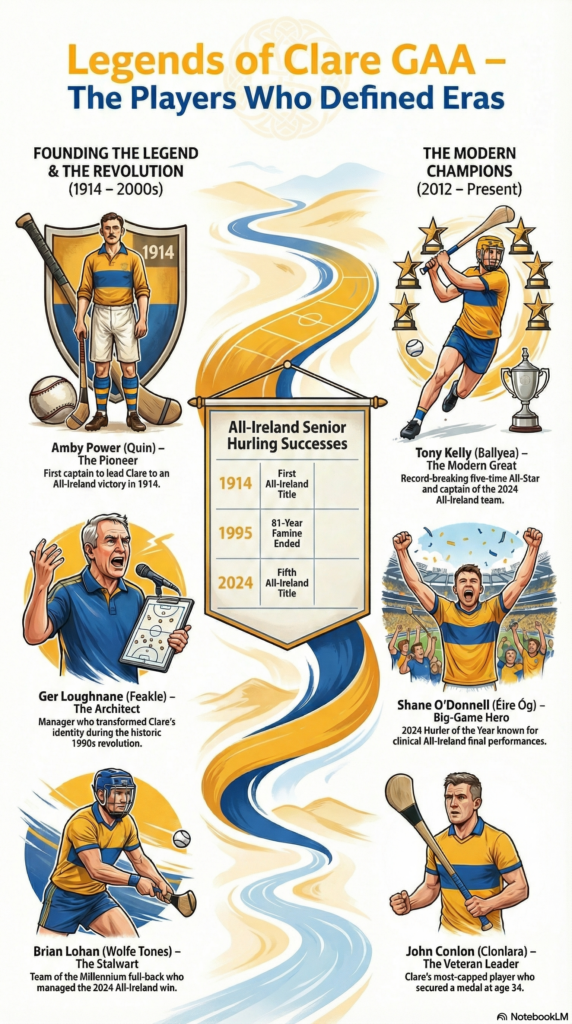
Legends of Clare GAA – The Players Who Defined Eras
Amby Power (Quin) – 1914
The first man to captain Clare to an All-Ireland. Power and his brother Joe were pioneers of the county’s hurling identity, traveling to games at their own expense on parish fields without markings or dressing rooms.
Jimmy Smyth (Ruan) – 1940s–1960s
Widely considered one of the greatest Clare hurlers before the modern era. Smyth powered Ruan to five county titles and was a joy to watch – a natural forward with an instinct for goals. His name is spoken with reverence in Clare to this day.
Ger Loughnane (Feakle) – Player 1973–1987, Manager 1995–2000
A player of passion and frustration – he lived through all those agonising Munster defeats in the 1970s. As a manager, he channeled that pain into the most dramatic transformation in GAA history. Without Loughnane, the Clare revolution simply doesn’t happen.
Anthony Daly (Clarecastle) – 1990s
The captain of the 1995 and 1997 All-Ireland teams. Daly’s speech after the 1995 Munster Final – raw, emotional, unforgettable – is one of the iconic moments in GAA history. He later managed Dublin’s hurlers and is now a leading GAA media voice.
Brian Lohan (Wolfe Tones, Shannon) – 1990s–2000s
Four All-Stars. Named on the Hurling Team of the Millennium. The best full-back of his generation, and possibly of any generation. As a manager, he delivered Clare’s fifth All-Ireland in 2024.
Jamesie O’Connor (St Joseph’s Doora-Barefield) – 1990s
The elegant forward who scored the winning point in the 1997 All-Ireland Final. Four All-Stars. Hurler of the Year 1997. A player of sublime skill and ice-cold finishing.
Seánie McMahon (St Joseph’s Doora-Barefield) – 1990s
Two All-Stars. One of the finest centre-backs in hurling history. McMahon was the foundation stone of Clare’s defence throughout the revolution years.
Davy Fitzgerald (Sixmilebridge) – 1990s–2000s (Player), 2012–2016 (Manager)
Won two All-Ireland medals as Clare’s goalkeeper, then came back to manage the county to a third. Fitzgerald’s tactical innovations – sweeper systems, short passing – changed how hurling was played. A divisive figure, perhaps, but one whose commitment to Clare was never in doubt.
Tony Kelly (Ballyea) – 2012–present
Five All-Stars – the most by any Clare hurler. Hurler of the Year 2013. Captain of the 2024 All-Ireland winning team. Kelly is the greatest Clare hurler of the modern era, and he’s not done yet. His goal in the 2024 final – flicking the ball over a defender, touching it on his hurley, burying it past the keeper – is already among the greatest moments in All-Ireland Final history.
Shane O’Donnell (Éire Óg) – 2013–present
Hat-trick hero of the 2013 final replay. Hurler of the Year 2024. A Harvard graduate and a PhD holder, O’Donnell is that rare thing: a truly world-class athlete who also happens to be one of the smartest people in the room. His 2026 season will be his last before emigrating.
John Conlon (Clonlara) – 2008–present
Clare’s most-capped hurler. Conlon has played in more championship games for the county than anyone else. He was an All-Star in 2024, fittingly, as he lifted the Liam MacCarthy at the age of 34 – a career that many feared would end without a medal.
All-Ireland Titles – The Full Record
| Year | Final Result | Manager | Captain |
| 1914 | Clare 5–1 Laois 1–0 | – | Amby Power |
| 1995 | Clare 1–13 Offaly 2–8 | Ger Loughnane | Anthony Daly |
| 1997 | Clare 0–20 Tipperary 2–13 | Ger Loughnane | Anthony Daly |
| 2013 | Clare 5–16 Cork 3–16 (replay) | Davy Fitzgerald | Patrick Donnellan |
| 2024 | Clare 3–29 Cork 1–34 (AET) | Brian Lohan | Tony Kelly |
Munster Senior Hurling Championship Titles
Clare have won six Munster SHC titles: 1889, 1914, 1932, 1995, 1997, and 1998.
The county’s Munster record is marked by long gaps and sudden bursts. From 1889 to 1914: 25 years. From 1914 to 1932: 18 years. From 1932 to 1995: 63 years. Then three in a row. Since 1998, Clare have not won the provincial title – but the round-robin format introduced in 2018 means teams no longer need to win Munster to reach the All-Ireland series.
National Hurling League Titles
Clare have won the National Hurling League five times: 1946, 1977, 1978, 1993 (Div 2), 2016, and 2024.
The 2016 win under Davy Fitzgerald came after a 38-year wait, beating Waterford in a replay. The 2024 win under Brian Lohan – beating Kilkenny in the final – signalled the intent that would carry through to All-Ireland glory.
What Clare GAA Means
Statistics tell the story of Clare GAA. Five All-Irelands. Six Munster titles. Twenty-three county champions from Newmarket-on-Fergus. A schoolteacher from the Burren who built the world’s biggest amateur sports organisation.
But numbers don’t capture the feeling of being in Cusack Park when the Banner are flying. They don’t capture the bonfires on the hills the night the cup comes home. They don’t capture the look on Tony Kelly’s face when he called Brian Lohan “a god of Clare hurling” from the Hogan Stand, or the tears in Ger Loughnane’s eyes the night the bus crossed the Shannon in September 1995.
Clare GAA is a story of belief against the odds. A county of 120,000 people that has, time and again, beaten counties three and four times its size. A county that waited 81 years between All-Irelands and never stopped believing the next one was coming.
The saffron and blue. The Banner County. A tradition that stretches from a famine cottage in the Burren to the steps of the Hogan Stand. And the story is still being written.
Sources: GAA.ie, Clare GAA, Michael Cusack Centre, Clare Museum, RTÉ Sport, Munster GAA, The Irish Times, Irish Examiner, Wikipedia, The42.ie