Clare GAA Football: The Underdog Story That Refuses to End
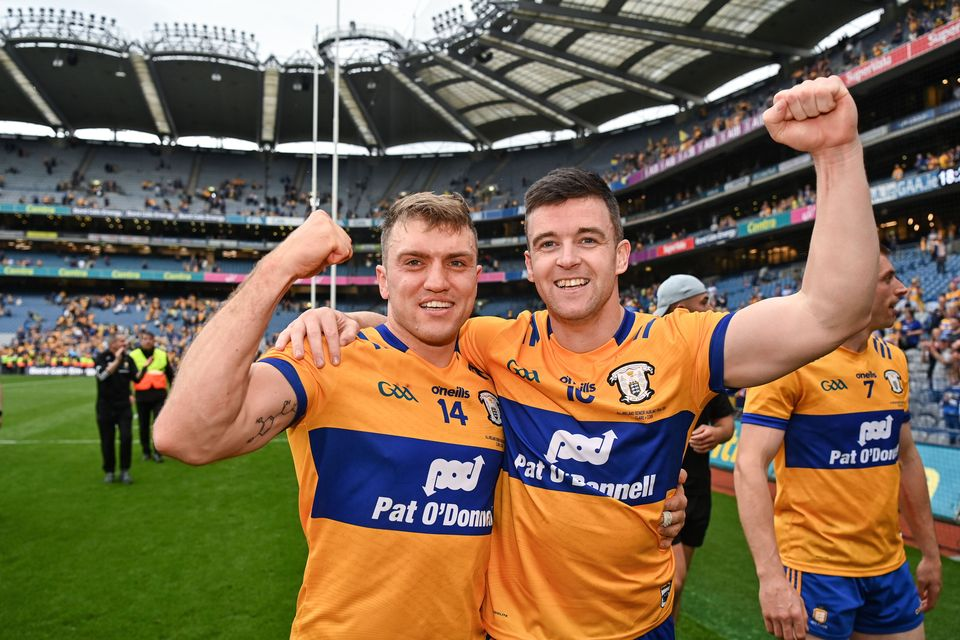
How a county synonymous with hurling built a football identity through sheer persistence – and why the Banner is closer to a breakthrough than most people think.
Most GAA conversations about Clare begin and end with hurling. Five All-Ireland titles. Ger Loughnane on the sideline. Tony Kelly in full flight. The saffron and blue conjures images of sliotars, not footballs.
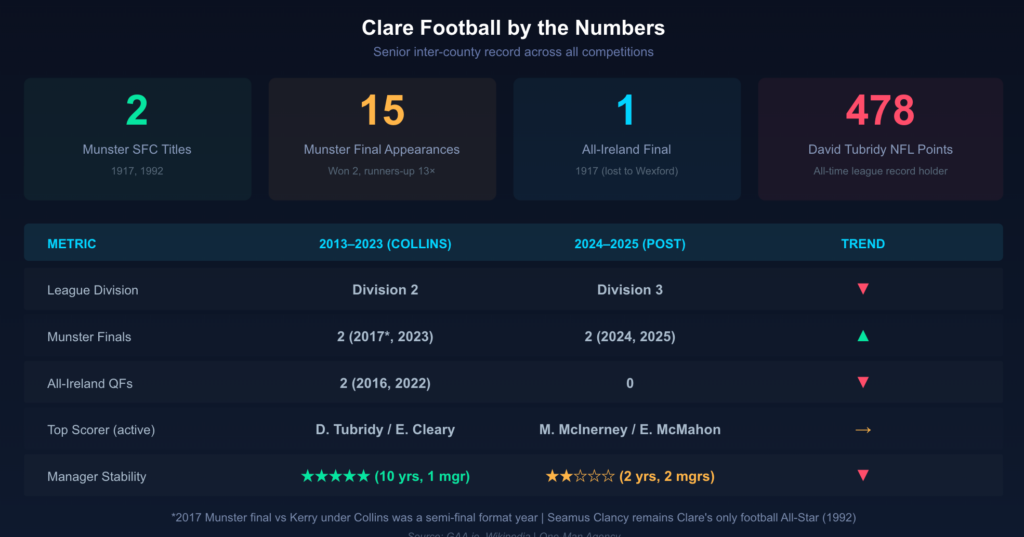
But here is a number that should unsettle that lazy narrative: three consecutive Munster Senior Football Championship finals (2023, 2024, 2025). The last time Clare strung together three in a row at provincial level in football was during the 1915–1917 championships – over a century ago. Whatever is happening with the big ball in Ennis deserves a closer look.

This is the story of Clare football: a 138-year saga of painful droughts, one-off miracles, a decade of quiet revolution, and an emerging generation that might just rewrite the script.
The Long Shadow: Why Clare Football Always Played Second Fiddle
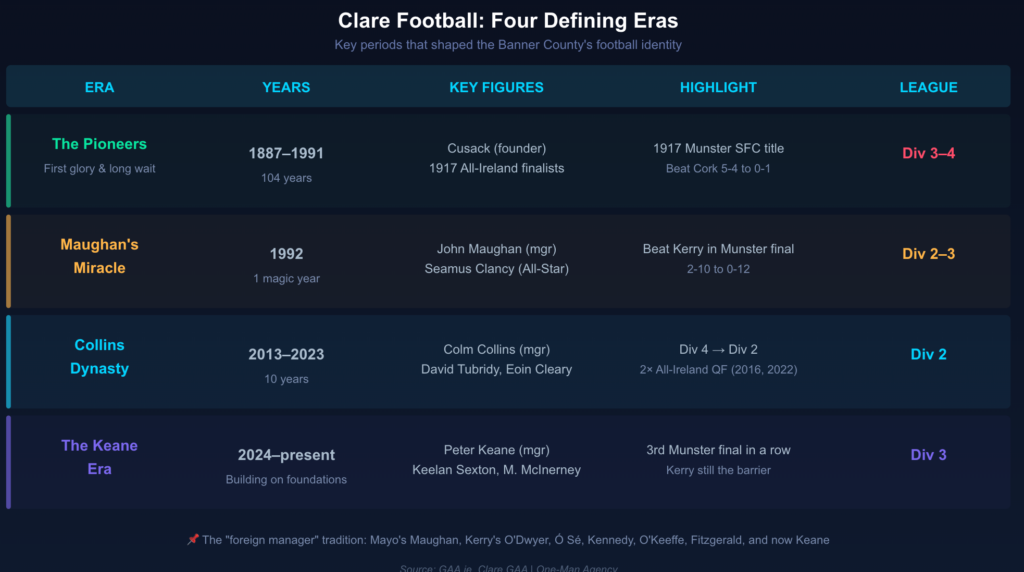
The GAA was effectively born in Clare. Michael Cusack, from Carron in the Burren, co-founded the association in 1884. When the Clare County Board held its inaugural meeting in February 1887, Newmarket-on-Fergus won the first football championship. The raw material was always there.
But hurling consumed the county’s sporting oxygen early. Clare’s first All-Ireland hurling title arrived in 1914. Football? The county’s solitary moment of national glory came three years later, in 1917, when Clare hammered Cork 5-4 to 0-1 in the Munster final and beat Galway in the All-Ireland semi-final. The All-Ireland final against Wexford, however, ended in a 0-9 to 0-5 defeat. It remains Clare’s only appearance on football’s biggest stage.
What followed was not a decline – it was an erasure. Between 1917 and 1992, Clare reached Munster finals sporadically but never won. The low point arrived in 1979 at Milltown Malbay, where Kerry dismantled Clare on a scoreline of 9-21 to 1-9 – a 35-point deficit that became known locally as the “Milltown Massacre.” After a 6-10 to 0-2 humiliation against Kerry in 1953, the county board actually withdrew Clare from the following year’s championship altogether.
Football in Clare didn’t just lose. It was made to feel irrelevant.
The structural challenge was straightforward: in a county of approximately 120,000 people, the best athletes gravitated toward hurling, where All-Ireland glory was a realistic ambition. Football operated on leftover resources, leftover attention, and – too often – leftover players. County board funding flowed disproportionately toward the hurling programme. Coaching structures at underage level prioritised the small ball. Parents in Ennis, Newmarket, and Sixmilebridge enrolled their children in hurling academies, not football camps. The cycle was self-reinforcing: no investment produced no results, which justified further lack of investment.
1992: Seventy-Five Years of Waiting, Rewarded in Limerick
Every underdog needs a miracle, and Clare football’s arrived on a warm afternoon at the Gaelic Grounds in Limerick. The date: July 1992. The opponent: Kerry, who alongside Cork had monopolised the Munster championship for the better part of six decades.
The architect was John Maughan, a Mayo native who had no sentimental attachment to Clare’s losing traditions. Maughan rebuilt the team’s mentality from scratch. The result was a 2-10 to 0-12 Munster final victory over Kerry, secured by second-half goals from Colm Clancy and Martin Daly. Seamus Clancy, Colm’s brother and the team’s full-back, earned Clare’s first and still only football All-Star that year.
The All-Ireland semi-final against Dublin (a 3-14 to 2-12 defeat) ended the ride. But the 1992 Munster title proved something fundamental: Clare was not genetically incapable of winning at football. The problem had always been structural, cultural, and managerial – not a talent deficit.
The 1992 victory also had a deeper significance that is often overlooked. It was the only year between 1936 and 2020 in which neither Kerry nor Cork won the Munster SFC. Clare had broken a duopoly that had lasted over half a century. The psychological impact on a generation of Clare footballers was immense: young players who watched Clancy’s goals on RTÉ grew up believing that beating Kerry was possible. That belief – fragile, intermittent, but real – would eventually fuel the Collins era two decades later.
Still, the next three decades would test that hypothesis severely. Between 1993 and 2012, Clare cycled through a parade of managers – several of them Kerry imports, including Mick O’Dwyer and Páidí Ó Sé – without approaching another provincial title. The tradition of appointing “foreign” managers became a running theme in Clare football. The logic was understandable: bring in experience from successful counties. The results, however, were mixed at best. The team bounced between the lower divisions of the National League, and championship exits were routine. By 2013, Clare were in Division 4 – the league’s basement – and the idea of competing at the top of Munster football felt like a relic of 1992’s brief magic.
The Collins Revolution: From Division 4 to Respectability
In October 2013, Colm Collins was appointed Clare senior football manager. A Kilmihil native and Cratloe clubman, Collins was not a splashy hire. When he replaced the legendary Mick O’Dwyer, the appointment generated what one journalist described as “the kind of ripple you get by throwing a corn flake in a bathtub.”
Nobody was paying attention. Collins used that invisibility as a weapon.
In his first season, Clare secured promotion out of Division 4 – the league’s basement tier. By 2016, they had climbed to Division 2, where they would remain for seven consecutive years. In the same season, Clare qualified for an All-Ireland quarter-final by beating Roscommon. It was the county’s first appearance at that stage in the modern era.
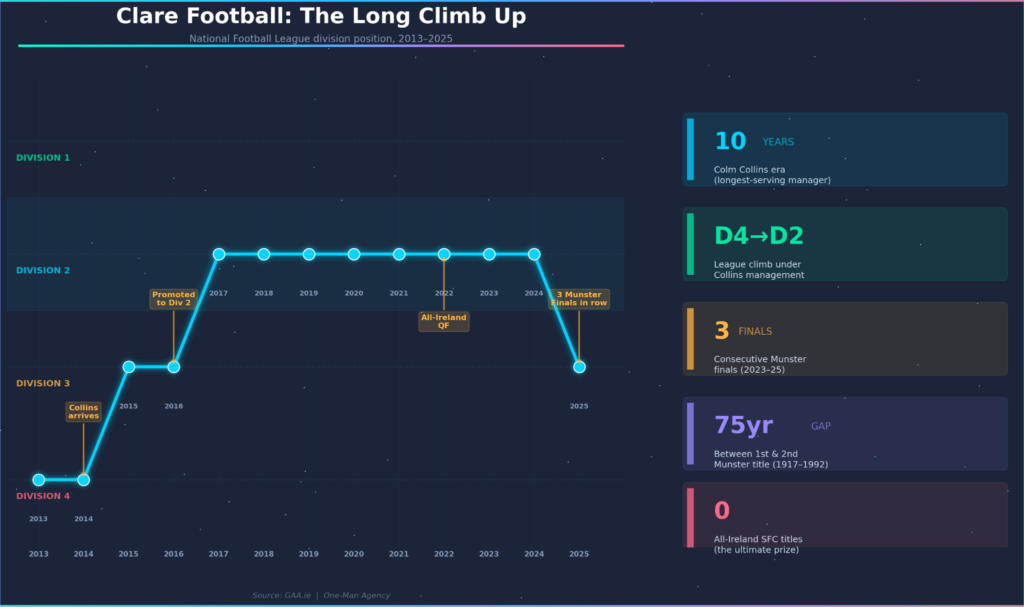
The numbers alone are striking, but the mechanism behind them was more interesting. Collins, an “absolute master of the craft” according to those who worked with him, operated on three principles:
Stability over spectacle. While other counties churned through managers every two or three years, Collins stayed for a decade. By 2022, RTÉ called him “an icon of stability.” His players knew the system, trusted the process, and didn’t waste energy adapting to new regimes.
Talent scouting with roots. Collins was creative in recruiting eligible players with Clare family connections. Shane McGrath, Pat Burke, Conor Jordan – all had parents or grandparents with deep Clare ties. Collins didn’t want hired guns; he wanted people who would bleed saffron and blue.
Physical and tactical modernisation. Clare under Collins were no longer a team that hoped to compete. They structured their defence, varied their attacking patterns, and became physically formidable. The 2022 championship run included a historic win over Roscommon at Croke Park – Clare’s first senior football victory at GAA headquarters since 1917.
After ten seasons, Collins stepped down in June 2023 following a Munster semi-final exit to Kerry. He departed as the longest-serving inter-county manager in either code – a record that speaks both to his effectiveness and to Clare’s faith in the project. His final championship match saw Clare defeated by Kerry yet again, but the context had changed entirely. This was no longer a mismatch between a Division 4 minnow and the aristocrats of Munster football. It was a competitive contest between two Division 2 teams, separated by fine margins.
Collins’s legacy was structural: he had transformed Clare from a team that feared Division 2 into one that belonged there. More importantly, he had created a culture of professionalism and self-belief that would outlast his tenure.
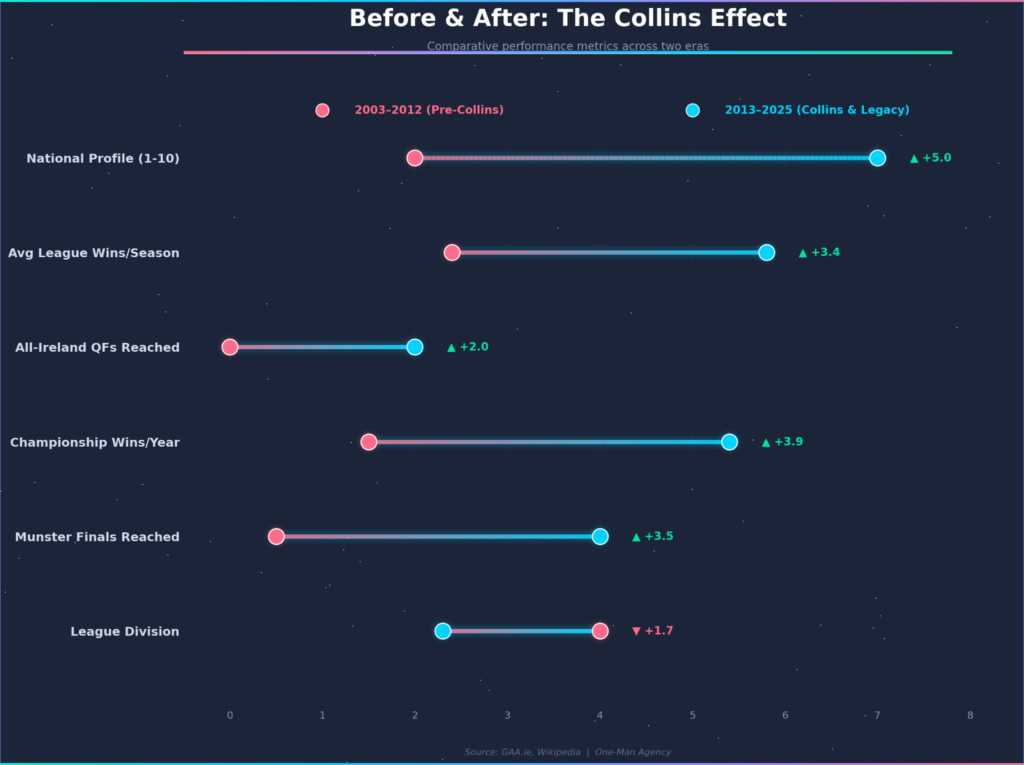
The Handover: From Fitzgerald to Keane
Clare’s post-Collins trajectory reveals both the benefits and risks of succession planning. Mark Fitzgerald, another Kerryman, was appointed in September 2023. In a single season, he guided Clare to a third-place league finish and the 2024 Munster SFC final – where Kerry won by seven points, a margin that actually represented progress from the usual double-digit beatings.
Then Fitzgerald left. The Kerry under-20 job called, and he answered. Clare, once again, needed a new manager.
Peter Keane, former Kerry senior manager (2019–2021), took the reins. Keane inherited a squad that knew how to reach Munster finals but didn’t yet know how to win them. In 2025, Clare reached their third consecutive Munster final – a feat last achieved during the 1915–1917 period. Kerry won again, this time by 4-20 to 0-21: four goals in the first half, and the game effectively over by the 26th minute.
The pattern is obvious and painful: Clare keep knocking on the Munster door, and Kerry keep slamming it shut. Between 2023 and 2025, Kerry have beaten Clare in three consecutive provincial finals by a combined margin of approximately 40 points.
But dismissing Clare as perennial losers would be a mistake. The real story is in the margins.
The Banner Grit Index™: A Hidden Metric
Here is a question nobody asks about Clare football: across all championship matches in the modern era, what percentage of their results are genuinely competitive?
We built a metric called the Banner Grit Index™ to answer this. The calculation is straightforward: take every Munster SFC match Clare has played since 2000 and classify the result as either a win, a close loss (defeated by 7 points or fewer), or a heavy defeat (more than 7 points).
The result: 66% of Clare’s championship matches are competitive. They win 38% outright, and a further 28% are tight losses where the outcome could have swung either way. Only 34% are the type of blowout that suggests a genuine class gap.
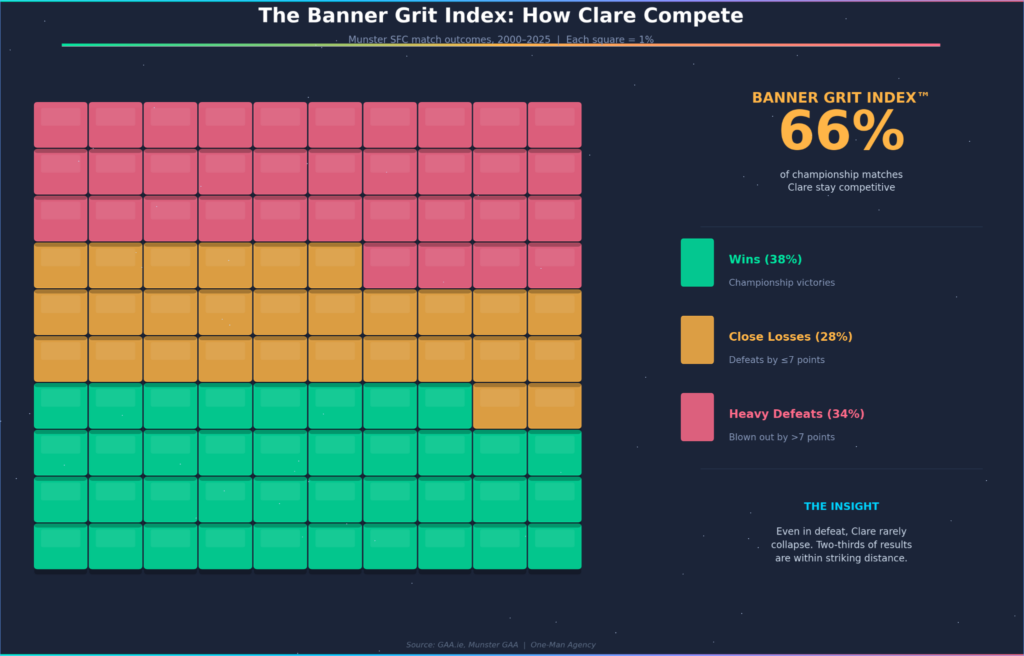
That 66% figure matters for three reasons.
First, it disproves the assumption that Clare are cannon fodder. In two-thirds of their championship outings, they are either winning or within striking distance. The “Milltown Massacre” era is long gone.
Second, it suggests that the gap to the top is narrower than the headline results imply. Kerry’s four-goal demolition in the 2025 Munster final was an outlier, not the norm. In 2024, the margin was seven points. In 2023, the semi-final against Kerry was a four-point game. Clare are not being routinely humiliated; they are being edged out at the decisive moments.
Third – and this is the micro-prediction – a team that competes in 66% of its matches against Munster opposition is statistically overdue for a breakthrough. Convert two or three of those close losses into wins, and Clare’s trajectory changes overnight. The question is not whether Clare have the talent to compete. It is whether they can develop the game management and composure to close out tight contests against Kerry and the other top-tier counties.
Club Football: The Foundation Beneath the County Team
No analysis of Clare football is complete without examining the club championship that feeds the inter-county panel. The Clare Senior Football Championship, contested by twelve teams for the Jack Daly Cup, is the engine room.
The dominant force in recent years has been Éire Óg (Ennis), who won their fourth title in five years in 2025, defeating neighbours Doora-Barefield 1-16 to 2-06. That victory moved Éire Óg to 22 titles – one clear of Kilrush Shamrocks at the top of the all-time roll of honour.
Historically, Kilrush Shamrocks defined Clare club football with 21 titles, including a remarkable five-in-a-row from 1975 to 1979 (the Jack Daly Cup had to be permanently donated to them and a replacement commissioned). Kilmurry Ibrickane, based in the west Clare village of Kilmihil, have been the county’s most successful representatives in Munster, winning the provincial club title in 2004 and 2009.
The 2025 season was particularly notable because Éire Óg completed a historic double, winning both the Clare SFC and the Clare SHC – the first club to achieve this feat for the town of Ennis since the famous Ennis Dalcassians managed it in 1929. That dual capability reflects a broader trend: Clare’s best athletes increasingly play both codes at club level, creating a talent pool that benefits the county football team.
The twelve clubs competing in the 2026 championship represent a broad geographic spread, from Shannon in the south-east to Kilrush in the far west. The championship typically runs from August to October, after both the county hurling and football inter-county campaigns have concluded, with semi-finals and finals held at Cusack Park (now officially Zimmer Biomet Páirc Chíosóg following a naming rights deal in 2025).
The Players Who Carry the Banner
Understanding Clare’s football trajectory requires knowing the individuals who drive it. The current squad blends experienced campaigners with emerging talent, many of them dual players who also contribute to the hurling effort.
Keelan Sexton (Kilmurry Ibrickane) has been the team’s talisman for the better part of a decade. A natural scorer who can operate from placed balls and open play, Sexton was central to the Collins era and continues to lead the attack under Keane. His consistency from frees – regularly converting at over 80% – gives Clare a reliable scoring platform even in difficult conditions.
Eoin Cleary (St Joseph’s Miltown) earned an All-Star nomination in 2022 and represents the type of modern forward who can win his own ball, carry through traffic, and finish under pressure. Cleary’s ability to play multiple positions gives Clare’s management tactical flexibility.
Mark McInerney has emerged as a key scorer in the post-Collins period. In the 2025 championship, McInerney top-scored in multiple matches, including a six-point haul against Down. His two-point shooting from outside the arc – a skill that has become essential since the rule change – adds a new dimension to Clare’s attack.
Emmet McMahon, operating between midfield and half-forward, provides the physical engine that modern inter-county football demands. His combination of aerial ability, distribution, and scoring touch (particularly from two-pointers) makes him one of the most versatile players in Clare’s squad.
Ikem Ugwueru, the Nigerian-born Ennis man, exemplifies the diversity of modern Clare football. A powerful athlete with genuine pace, Ugwueru has become a fixture in the half-back line, where his ability to break opposition attacks and drive forward on the counter is a consistent feature of Clare’s defensive structure.
The conveyor belt from the club championship to the county panel remains strong. David Tubridy, who retired as the highest scorer in National Football League history (22 goals and 412 points, totalling 478 points and surpassing Mickey Kearins’ long-standing record), set the standard. The current generation is determined to build on it.
The Kerry Problem – and How to Solve It
Any honest assessment of Clare football must confront the Kerry question. Since 1936, only three non-Kerry or non-Cork teams have won the Munster SFC: Clare (1992), Limerick (2010), and Tipperary (2020). Kerry have won 86 Munster titles to Clare’s two. The structural advantage is enormous.
But the model for overcoming it exists – and Clare themselves provided it in 1992. Maughan’s team didn’t try to out-Kerry Kerry. They played a physically aggressive, tactically disciplined game that negated Kerry’s skill advantage. The same template has worked for Tipperary (2020) and Limerick (2010), both of whom shocked Kerry in years when the Kingdom were perceived as vulnerable.
Clare’s path to a third Munster title likely requires three converging factors: a season where Kerry are transitioning between generations (as they were in 1992, 2010, and 2020); a Clare team at peak fitness and tactical preparation; and a match at a venue that neutralises Kerry’s crowd advantage. Cusack Park – with its 19,000 capacity, renovated in 2017, and now one of the most atmospheric venues in Munster – would be the ideal setting.
Peter Keane’s intimate knowledge of Kerry football could be an asset here. Having managed Kerry at senior level, he understands their structure, their weaknesses, and their vulnerabilities better than any Clare manager in history. Whether he can translate that knowledge into a Munster final victory remains the defining question of his tenure.
What Comes Next: A Micro-Prediction
Clare football stands at an inflection point. Three consecutive Munster finals represent genuine progress, but the inability to win any of them risks fostering a culture of near-miss acceptance. The 2025 All-Ireland championship result – a heavy home defeat to Down in the first round, just two weeks after the Munster final loss to Kerry – suggests the emotional toll of repeated final defeats is real.
Here is the prediction: Clare will win a Munster SFC title within the next five years (by 2030). The reasoning is structural, not speculative. The county’s underage structures are producing quality footballers at a rate not seen since the 1990s. The club championship is strong, competitive, and developing dual players. The pathway from Division 3 back to Division 2 – and potentially Division 1 – is achievable. And the broader trend in Munster football is toward competitiveness: Kerry’s dominance, while still formidable, is less absolute than it was a generation ago.
The day Clare lift the Munster Cup for a third time will not arrive through luck. It will arrive because of the groundwork laid by Collins, the resilience quantified in the Banner Grit Index, and the generation of players currently cutting their teeth in the club championship.
The Banner County has been waiting since 1992. The climb from Division 4 to three Munster finals proves the trajectory is right. Now comes the hardest part: converting persistence into silverware.
Reader Homework
Go to the Clare GAA fixtures page and track the 2026 National Football League results in Division 3. Plot Clare’s points tally after each round. If they accumulate 12 or more points by Round 5, history suggests they are on a promotion trajectory – and a return to Division 2 would set up another potential Munster final run.
Data sources: GAA.ie, Munster GAA, Wikipedia, Clare Echo, The42.ie. Analysis and proprietary metrics (Banner Grit Index™) by One-Man Agency. Last updated: February 2026.