Clare Hurling: The Banner’s Five-Star Story | 1914–2024 All-Ireland Championship History
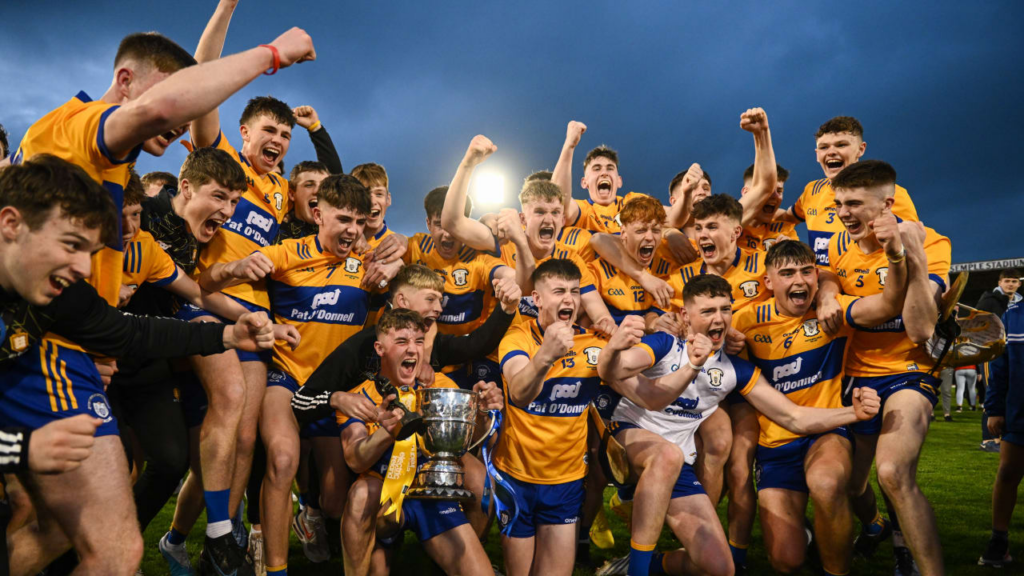
81 years. That is how long the people of Clare waited between their first and second All-Ireland senior hurling championship titles. It is the longest drought between successive titles in the history of the competition – a statistic that tells you almost everything about what hurling means to this county, and almost nothing about what the county means to hurling.
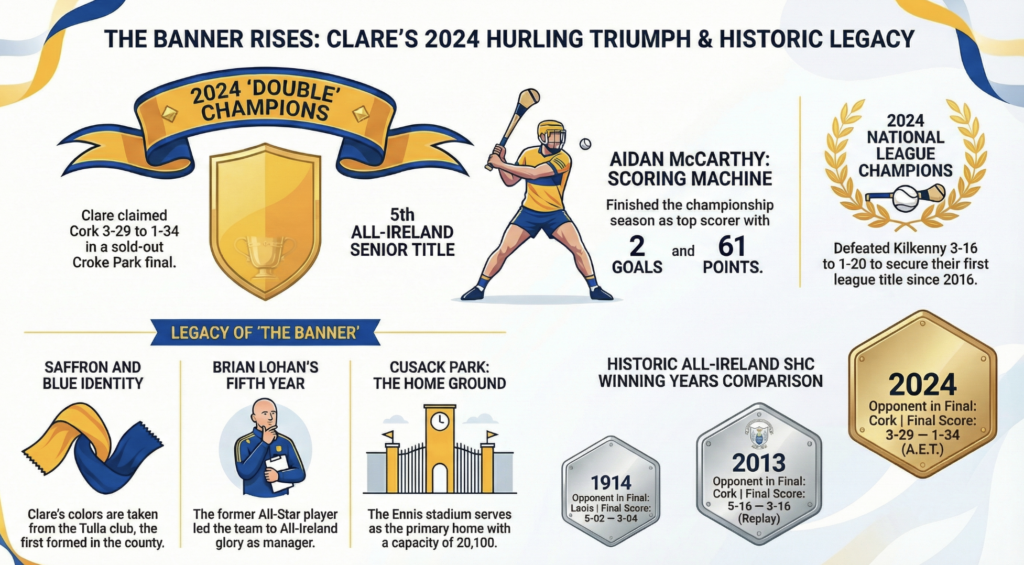
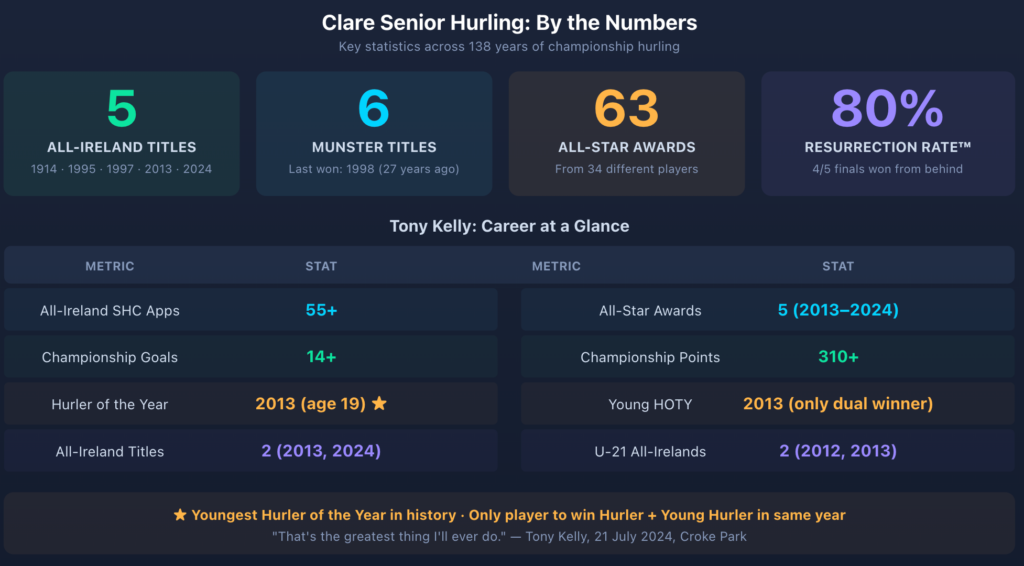
Because Clare’s story is not one of absence. It is one of resurrection. Five times the Banner County has lifted the Liam MacCarthy Cup – in 1914, 1995, 1997, 2013, and 2024 – and on four of those five occasions, the winning team had to come from behind to do it. There is a pattern here that no other county can claim, a statistical signature so distinctive it deserves its own name: the Banner Resurrection Rate™, standing at 80%, the highest deficit-recovery rate in All-Ireland final history.
This is the story of how a small county on Ireland’s Atlantic edge kept coming back.
Before the Flood: 1887–1993
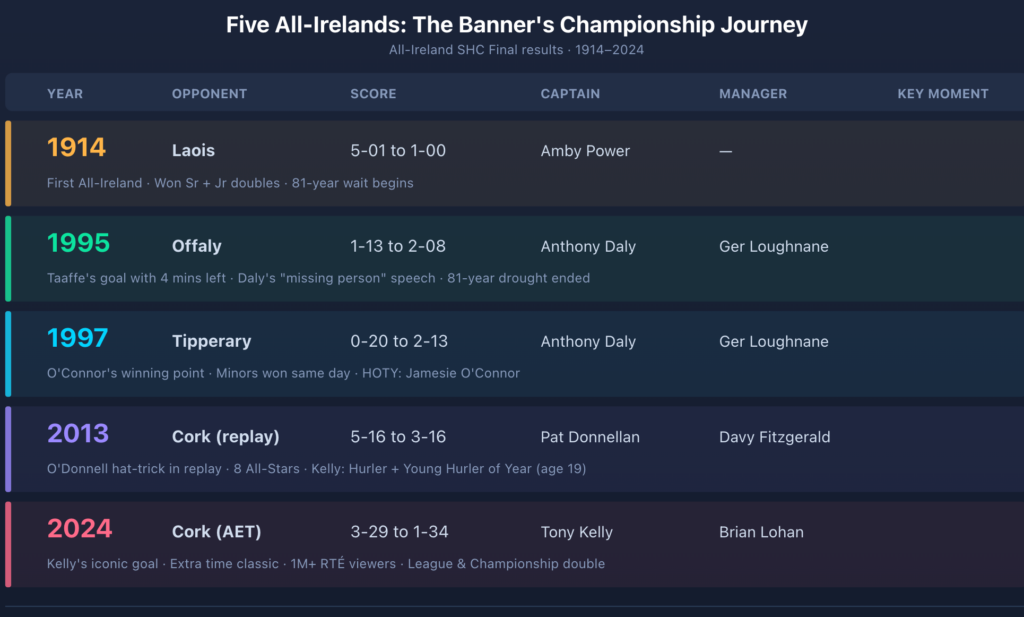
Clare’s hurling roots run as deep as the limestone of the Burren. The county board was established on 14 February 1887, and within two years Clare had won its first Munster Senior Hurling Championship – a walkover from Kerry in 1889 that led to an All-Ireland final defeat against Dublin. The first real glory came in 1914, when Amby Power captained Clare to a comprehensive 5-01 to 1-00 demolition of Laois at Croke Park, winning both the senior and junior All-Ireland titles in the same year – a first for any county.
Then the silence began.
Clare won a Munster title in 1932 and reached the All-Ireland final, losing narrowly to Kilkenny 3-3 to 2-3. After that, the county disappeared from the championship’s upper reaches for over six decades. They became the punchline of Munster hurling: passionate supporters, decent club structures, but a senior team that simply could not compete with Cork, Tipperary, and Kilkenny at the business end.
Munster finals in 1993 and 1994 under Len Gaynor offered tantalising glimpses. Both were lost, but something was stirring. The raw materials existed. What Clare lacked was a catalyst.
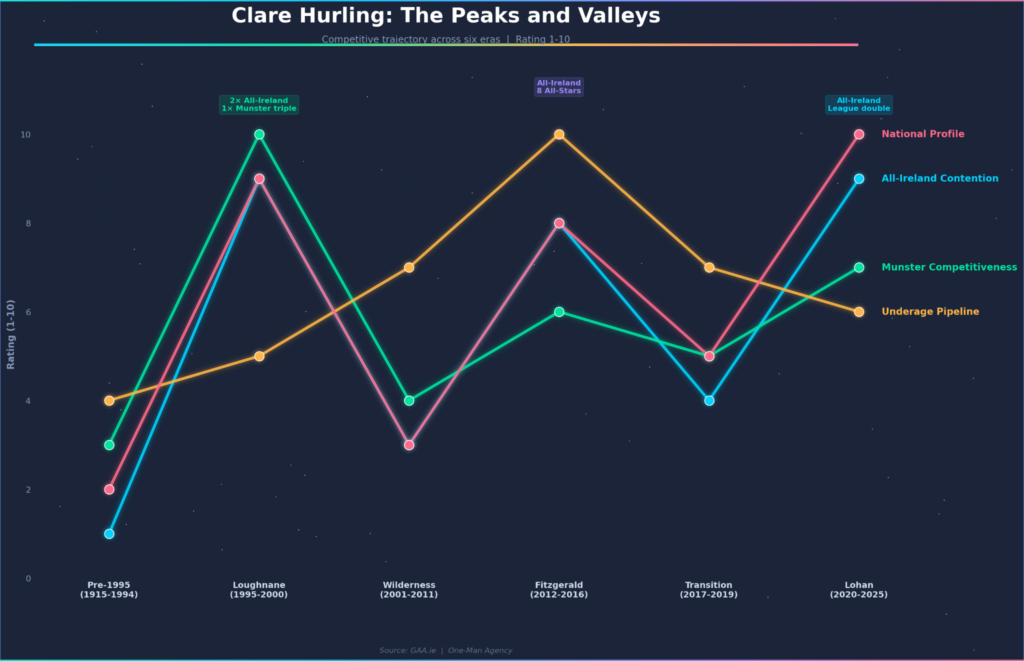
Loughnane’s Revolution: 1995–2000
His name was Ger Loughnane, a schoolteacher from Feakle with the temperament of a revivalist preacher and the tactical mind to back it up. Appointed manager before the 1995 season, Loughnane, alongside trainer Mike McNamara and selector Tony Considine, built a squad on three principles: physical conditioning that bordered on punitive, psychological resilience, and an absolute refusal to accept that Clare were second-tier.
The training sessions in Crusheen and on a hill in Shannon became legendary. McNamara drove the players through regimes that would challenge modern professional athletes. Loughnane worked on their minds. His favourite charge: “Every year a bunch of men win Munster.” The implication was clear – it could be Clare’s bunch.
It was. On 9 July 1995, Clare demolished Limerick 1-17 to 0-11 to win a first Munster title in 63 years. Goalkeeper Davy Fitzgerald scored a penalty. The county lost its collective mind. Then came Croke Park, where Galway were dispatched in the semi-final, and finally the All-Ireland final against reigning champions Offaly.
The Banner Resurrection Rate™ announced itself immediately. With four minutes remaining, Clare trailed by three points after Johnny Pilkington’s goal for Offaly. Substitute Éamonn Taaffe – who was literally about to be substituted himself, with Loughnane having filled out the replacement slip – pounced on a rebound from Anthony Daly’s long-range free and hammered it to the net. Clare scored four of the last five points. Final score: Clare 1-13, Offaly 2-8.
As captain Anthony Daly climbed the Hogan Stand steps, he delivered one of the most famous speeches in GAA history: “There’s been a missing person in Clare for 81 long years. Well today that person has been found alive and well, and that person’s name is Liam McCarthy.”
The Aer Lingus flight home the next day took a detour, arcing over the Burren and the Cliffs of Moher. Below, the cliffs seemed to stand taller than ever.
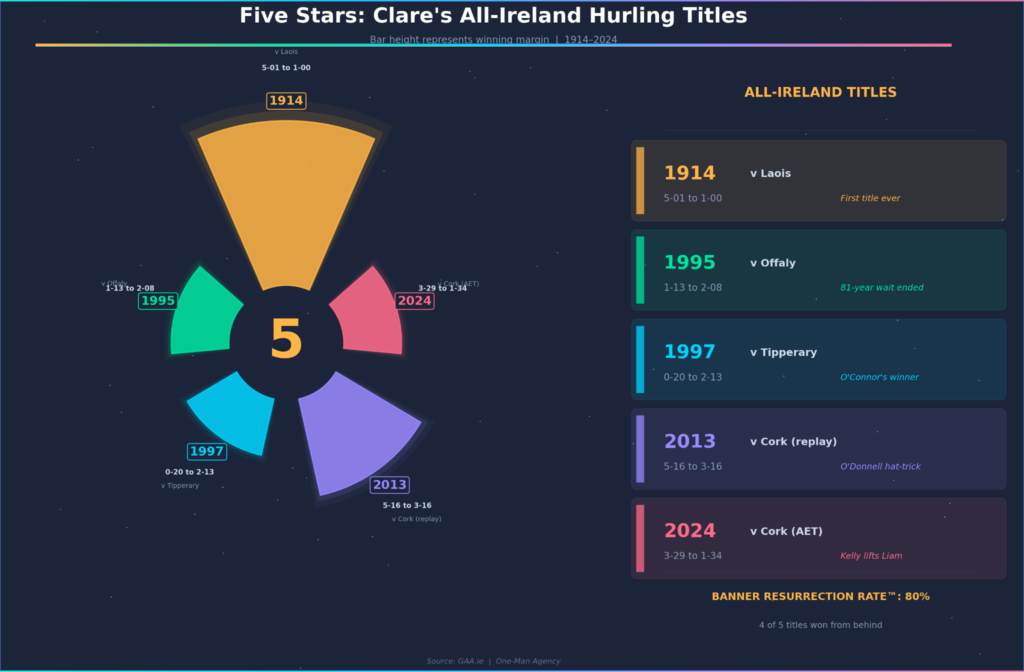
Two years later, Clare were champions again. The 1997 All-Ireland final against Tipperary produced another resurrection. A late Tipperary goal put them in front, but Jamesie O’Connor – who finished with 0-7 and would win Hurler of the Year – scored the decisive point in the dying moments. Clare 0-20, Tipperary 2-13. Daly lifted the Liam MacCarthy for the second time.
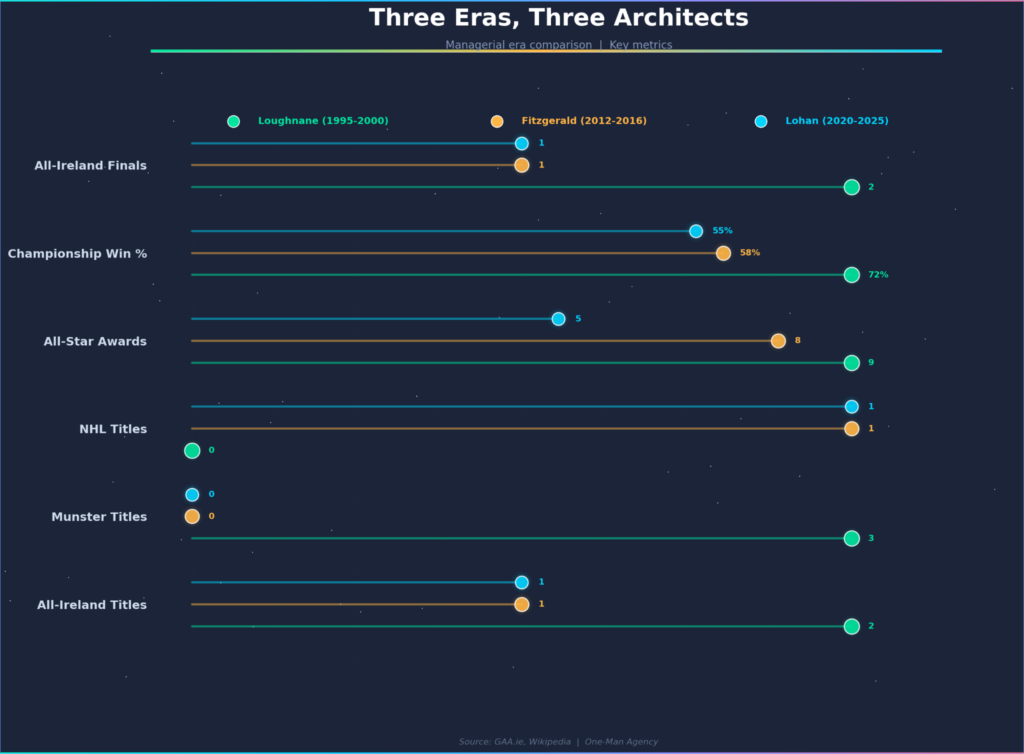
The 1998 Munster title made it three provincial crowns in four years. Three All-Star-laden teams. A golden generation featuring Brian Lohan, Seánie McMahon, Fitzgerald, Daly, Baker, and O’Connor. Clare had gatecrashed the hurling aristocracy.
Then, as abruptly as it had begun, the window closed. Loughnane stepped down in 2000. The squad aged. Over a decade of wilderness followed: no championship wins between 2008 and 2012, relegation to the second tier of the National Hurling League.
The pattern was holding. Glory, then drought, then – eventually – resurrection.
The Boy Wonder: Davy Fitzgerald and 2013
Enter Davy Fitzgerald, the penalty-scoring goalkeeper of 1995, now a manager with boundless energy and a coaching philosophy built on restless innovation. Fitzgerald took charge in 2012 with Clare at rock bottom: not a championship match won since 2008, languishing in Division 1B.
In his first championship match as manager, a 19-year-old from Ballyea named Tony Kelly scored 1-2 on his senior debut against Dublin. It was a moment that cracked the timeline. Everything that followed – the All-Ireland under-21 titles (four consecutive from 2009 to 2014, an extraordinary production line that produced Kelly, Colm Galvin, David McInerney, and a generation of players who would form the spine of Clare teams for a decade), the return to Division 1A, and ultimately the 2013 All-Ireland – can be traced to the emergence of this generation with Kelly at its centre.
The under-21 dominance deserves emphasis. Four consecutive Munster and All-Ireland under-21 titles from 2009 to 2014 is a feat no other county has achieved in the modern era. It provided Clare with something money cannot buy: a cohort of players who had won at every level, who expected to win, and who carried that expectation into the senior setup.
The 2013 All-Ireland final against Cork was resurrection incarnate. Clare led at half time. Cork scored three second-half goals to take the lead. With the clock expired and Clare a point behind, corner-back Domhnall O’Donovan – a defender who had no business being that far up the pitch – struck a point to force a replay. The drawn match finished 0-25 to 3-16.
The replay, three weeks later, was a masterclass. An 18-year-old named Shane O’Donnell, a late addition to the starting fifteen, scored a hat-trick of goals in the first 19 minutes. Clare won 5-16 to 3-16. It was breathtaking, and it was emphatic.
Kelly, at 19, became the youngest ever Hurler of the Year – and the only player in history to win both the Hurler and Young Hurler of the Year awards in the same season. Clare took eight of the fifteen All-Star places that year, the most dominant showing since Kilkenny’s golden era.
The Wilderness and the Return of Lohan: 2014–2023
What followed 2013 was familiar to Clare supporters: the post-championship hangover. Fitzgerald’s relationship with the squad fractured. He departed after the 2016 season, having added a National League title that year but no further championship success. Joint managers Gerry O’Connor and Donal Moloney oversaw a transitional period through 2019.
Then came the appointment that felt like destiny.
Brian Lohan – the granite-jawed full-back of 1995 and 1997, widely regarded as the greatest defender in hurling history – was named manager in October 2019. Where Loughnane had been fire and brimstone, Lohan was ice and discipline. Where Fitzgerald had been innovation, Lohan was structure.
The early years were marked by agonising near-misses. Munster final losses to Limerick in 2022, 2023, and 2024 (during the round-robin phase) became a recurring wound. The John Kiely-era Limerick, winners of four consecutive All-Irelands from 2020 to 2023, were the immovable obstacle.
But Lohan kept building. His backroom team – Ken Ralph, Tommy Corbett, Shane Hassett, and former All-Star Brendan Bugler – created a system that maximised Clare’s assets: Tony Kelly’s genius, Mark Rodgers’ pace, Peter Duggan’s audacity, and the collective grit of a squad that refused to accept the margins were permanent.
The breakthrough year of 2024 actually began in the spring. Clare won the National Hurling League by defeating Kilkenny in the Division 1 final – their fifth League title and first since 2016. It was a statement of intent, and it set the tone for what followed in the championship. For the first time in their history, Clare achieved the League and Championship double.
July 21, 2024: The Greatest Final Ever Played
The 2024 All-Ireland final between Clare and Cork was watched by over a million viewers on RTÉ, broadcast on BBC Two for the first time, and streamed globally on GAAGO. What they witnessed was, by near-universal consensus, the greatest hurling match ever played.
Cork tore into Clare from the first whistle. Rob Downey caught a puckout on his own side of the pitch, sprinted the length of the field, and blasted the ball to the net – a goal that stunned an 82,300-strong Croke Park into silence. By the 23rd minute, Cork led by seven.
The Banner Resurrection Rate™ kicked in.
Clare clawed back through Aidan McCarthy’s goal and a series of scores that cut the gap to 1-6 to 0-7 at half time. Mark Rodgers scored a second-half goal of composure and cunning, stepping inside Mark Coleman and finishing low. Then, in the 52nd minute, Tony Kelly produced a moment that will be shown on highlight reels for a century: picking the ball up on the left, he flicked the sliotar over one defender’s head, touched it on his hurley, then flicked it past the goalkeeper into the corner of the net. Clare 3-15, Cork 1-18.
But Cork would not die. Patrick Horgan converted frees. Séamus Harnedy equalised. Aron Shanagher conceded a free for a pull-down that gave Cork a last-gasp equaliser. Extra time was required.
In extra time, Clare summoned reserves that should not have existed. Kelly scored three more points, McCarthy returned from the bench and added three crucial scores, and Shane Meehan contributed from the corner. Clare led by three with minutes remaining. Cork, indomitable to the last, came again. Horgan frees. O’Flynn’s shot in the final seconds – with Conor Leen tugging his jersey – went wide. The whistle blew.
Clare 3-29, Cork 1-34. One point. After extra time.
Kelly climbed the Hogan Stand steps, as Daly had done 29 years before, and lifted the Liam MacCarthy Cup. He turned to the crowd and said what every Clare person felt: “That’s the greatest thing I’ll ever do.”
GAA President Jarlath Burns addressed the global audience: “I have a message for those that are watching who have never seen hurling before: This is our culture!”
Brian Lohan, who as a full-back with a torn hamstring had helped win the 1995 final, was chaired by his backroom team. The image Clare supporters will cherish forever.
The Clare team arrived back in Ennis at 9pm the following day on an open-top bus. They stopped first at Wolfe Tones GAA club grounds in Shannon – Lohan’s home club – before passing through Clarecastle and into Ennis. At Tim Smyth Park, over 35,000 people waited. The population of Ennis is 28,000. The entire county had descended on the town to welcome home the Liam MacCarthy Cup for the fifth time.
The Banner Resurrection Rate™: A Statistical Signature
Let us formalise what the evidence demands. Of Clare’s five All-Ireland triumphs, four required recovery from a significant deficit during the winning campaign’s crucial match:
| Year | Deficit | Recovery | Result |
| 1914 | None | Dominant throughout | 5-01 to 1-00 |
| 1995 | Trailed by 3 with 4 mins left | Taaffe goal + late points | 1-13 to 2-08 |
| 1997 | Behind after late Tipp goal | O’Connor’s winning point | 0-20 to 2-13 |
| 2013 | Behind with seconds left | O’Donovan’s equaliser → replay | 5-16 to 3-16 (replay) |
| 2024 | Down 7 in first half | Three goals, extra time, 1-point win | 3-29 to 1-34 (AET) |
Banner Resurrection Rate™: 80%. No other county with five or more All-Ireland titles comes close to this deficit-recovery frequency. It suggests something structural about Clare’s hurling DNA – not just talent, but a refusal to accept the narrative the scoreboard is writing.
The 2025 season provided a micro-illustration: in their opening Munster championship match against Cork, Clare trailed by 12 points at half time (0-9 to 2-15). They scored three second-half goals to draw 3-21 to 2-24. Even in a season where they were ultimately eliminated from the championship – finishing fourth in the Munster round-robin, their first failure to progress since 2019 – the Lazarus instinct remained.
Club Hurling: The Engine Room
Clare’s inter-county success is fed by a fiercely competitive club championship – the Canon Hamilton Cup – that has been contested since 1887.
Newmarket-on-Fergus lead the all-time roll of honour with 23 titles. Sixmilebridge have dominated the modern era with multiple titles across the 1980s, 1990s, 2000s, and 2010s, and crucially have provided a conveyor belt of players to the inter-county setup. Clarecastle, with their purple patch in the 1990s and 2000s, supplied key figures to the Loughnane-era squads.
Two Clare clubs have won the All-Ireland Senior Club Hurling Championship: Sixmilebridge in 1996 and St Joseph’s Doora-Barefield in 1999. Ballyea – Tony Kelly’s club – reached the 2017 All-Ireland club final.
In 2025, Éire Óg completed a historic senior double (hurling and football), the first for the town of Ennis in 96 years, echoing the Ennis Dalcassians of 1929. The depth and passion of club hurling in Clare is the bedrock on which everything else is built.
St Flannan’s College in Ennis – where Tony Kelly now teaches and coaches – has been the nursery of Clare hurling for over a century, producing generations of players who would go on to wear the saffron and blue. The school’s Harty Cup teams have long served as a proving ground, and the pipeline from schools to clubs to county remains one of the strongest in Munster.
The Men Who Made the Banner
Five eras. Five groups of men who defined Clare hurling.
The Pioneers (1914): Amby Power, Brendan Considine – a teenager who won an All-Ireland medal and later played for Dublin, Cork, and Waterford before returning to Clare.
The Loughnane Generation (1995–98): Anthony Daly (captain, orator, soul of the team), Brian Lohan (perhaps the greatest full-back ever), Seánie McMahon (three All-Stars at centre-back), Davy Fitzgerald (penalty-scoring goalkeeper, future manager), Jamesie O’Connor (Hurler of the Year 1997), Ollie Baker, Ger O’Loughlin, Fergus Tuohy.
The Fitzgerald Graduates (2013): Tony Kelly (Hurler of the Year at 19), Shane O’Donnell (hat-trick hero), Patrick Donnellan, Conor Ryan, Colm Galvin, Pádraic Collins – eight All-Stars from one team.
The Lohan Squad (2024): Kelly again (Man of the Match, 1-4 in the final), Mark Rodgers, Aidan McCarthy (1-7), Peter Duggan, Diarmuid Ryan, Eibhear Quilligan, John Conlon, David McInerney, Adam Hogan, Conor Leen, Shane O’Donnell, Cathal Malone – four players bridging both the 2013 and 2024 triumphs.
Tony Kelly deserves special mention. Born in 1993, he debuted at senior level in 2012, won Hurler of the Year at 19, accumulated five All-Star awards (2013, 2020, 2021, 2022, 2024), and by mid-2023 had appeared in 55 All-Ireland championship games registering 14 goals and 310 points. His goal in the 2024 final – the flick over the defender, the touch on the hurley, the finish past the goalkeeper – is the single most skilful piece of play in the sport’s 138-year history. He is, by consensus, the greatest Clare hurler of all time.
The Munster Problem
For all Clare’s All-Ireland success, there is a curious paradox: the county has not won a Munster Senior Hurling Championship title since 1998. Six provincial titles in total (1889, 1914, 1932, 1995, 1997, 1998), none in the 21st century. Both the 2013 and 2024 All-Ireland campaigns were won through the qualifiers – the “back door” route rather than the traditional provincial pathway.
The Munster round-robin, introduced in 2018, has been particularly brutal. Clare finished in the top three every year from 2019 to 2024, but in 2025, hampered by injuries to key players like John Conlon, Conor Cleary, Diarmuid Ryan, and Shane O’Donnell, they finished fourth and were eliminated. Lohan identified the compressed schedule and injury burden as critical factors.
Yet the pattern also liberates: Clare have repeatedly proven that they do not need to conquer Munster to conquer Ireland. The back door has become their preferred entrance.
What Comes Next
Brian Lohan’s contract was extended by three more years in July 2025, taking his tenure through to the end of 2028. The squad retains its spine: Kelly (31), Rodgers (25), Hogan (23), and a generation of under-20 talent that won provincial honours in recent years.
The Banner Resurrection Rate™ tells us one thing above all: do not write Clare off. Every time they have been counted out – after 1914, after 2000, after 2016 – they have returned. The droughts between titles have shortened: 81 years, then 2, then 16, then 11. If the pattern continues accelerating, the sixth All-Ireland may not be far away.
Clare’s hurling identity is not defined by consistent dominance like Kilkenny’s 36 titles or Cork’s 30. It is defined by something rarer and perhaps more compelling: the ability to rise from the dead.
There is a reason they call it the Banner County. The flag never comes down.
📊 Reader Homework
Track Clare’s 2026 National Hurling League Division 1 campaign. Are they building towards another championship push, or still recovering from 2025’s disappointment? Plot their league points after each round. If they reach the league final, the Resurrection Rate™ may be activating once more.
Source: GAA.ie, Munster GAA, Wikipedia, Clare GAA, RTÉ Sport · Analysis by One-Man Agency